Salary vs Dividends vs HSA — Compensation Mix for Incorporated Canadians
HSA plans let incorporated owners pay health costs pre-tax through their corporation.

Most incorporated Canadians frame the question as salary versus dividends. That framing answers how to get money out of the corporation. It says nothing about how to pay for health costs.
It usually arrives as a payroll decision, built around tax rates. Raymond James notes that the tax rate differential between salary and non-eligible dividends has narrowed to something fairly marginal in most provinces, including Ontario. Tax rates alone cannot settle the question anymore, and treating them as the deciding factor misses most of what actually separates salary from dividends: RRSP room, CPP entitlement, mortgage qualification, and now, eligibility for a tax-advantaged health plan.
Health costs don't vanish because an owner picked salary over dividends, or dividends over salary. Those costs remain a personal, after-tax expense unless the corporation pays them through a plan that turns them into a deductible business expense. A Health Spending Account, structured properly as a Private Health Services Plan (PHSP), is the mechanism that does that. It covers health costs pre-tax through the corporation, sitting alongside salary and dividends. Frontier HSA, a pay-as-you-go HSA administrator, structures corporate health spending this way: incorporated owners reimburse eligible medical expenses as claims come in, without the fixed monthly premiums that come with traditional group insurance. That third tool is what the rest of this piece puts in its proper place.
What salary costs inside a corporation
Salary is wages paid by the corporation to the owner as an employee. It is a deductible corporate expense, it generates RRSP contribution room, and it builds CPP entitlement. It also carries a payroll compliance burden and a CPP cost that employees on someone else's payroll never see directly, because their employer absorbs half of it without discussion.
Simplified Accounting's 2026 guide lays out the mechanics, and they follow a fixed sequence. The corporation registers a payroll account, withholds income tax and CPP at source, remits those withholdings to the CRA on a regular schedule, and issues a T4 at year-end. Every dollar paid as reasonable salary reduces the corporation's taxable income before corporate tax gets calculated. Salary also counts as earned income, and earned income is what generates RRSP contribution room. Dividends don't do that, a distinction that matters more than it first appears. Salary also counts toward CPP entitlement, so it builds a guaranteed, indexed income stream you can count on in retirement no matter how markets perform that year.
The CPP cost is where salary's price tag becomes concrete. Gondaliya CPA's 2026 guide puts the combined employee and employer CPP rate at 11.9%. Incorporated owners sit on both sides of the employment relationship, so they pay both halves through their corporation. MaxRefund's 2026 breakdown points out that many owners treat this as a mandatory cost to minimize, while it is, at the same time, building a pension benefit. Whether that trade-off makes sense depends on the owner's retirement savings, risk tolerance, and how many contributing years remain before retirement.
The RRSP room consequence appears starkly in a pattern Gondaliya CPA documents directly: a founder who took dividends only for three years discovered they had built no RRSP room at all across that stretch. Room lost in dividend-only years cannot be rebuilt retroactively. That's a permanent forfeiture, not a deferral, and it's the clearest argument for keeping some salary in the mix even when dividends look more attractive on a pure tax-rate basis. The CPP obligation adds a payroll compliance layer behind it. Both costs are why dividends still look genuinely attractive to a lot of incorporated owners.
Where dividends fit in the compensation mix
Dividends are paid out of after-tax corporate profits. They carry no CPP obligation and no payroll remittance requirement, and personal tax on them runs through the gross-up and dividend tax credit system at preferential rates. They build no RRSP room, no CPP, and none of the income a mortgage lender wants to see.
The mechanics differ from salary at every step. The corporation pays corporate tax on its profits first. The shareholder then receives dividends out of what's left, reported on a T5. There's no payroll account to register, no remittance schedule to track, no source deductions to calculate, which makes dividends administratively simpler than salary on paper. The gross-up and dividend tax credit system exists to approximate what tax professionals call integration: the personal tax owed on a dividend, combined with the corporate tax already paid on that income, should land close to the personal tax that would have applied to the same amount paid as salary. Simplified Accounting's 2026 guide walks through that mechanism in detail.
Two kinds of dividends get taxed differently. Eligible dividends come from income taxed at the general corporate rate, so they get a stronger personal tax credit. Non-eligible dividends, paid from income taxed at the small business rate, are the more common case for CCPCs operating within the Small Business Deduction (SBD) limit. Cassar CPA's 2026 analysis lays out Ontario's marginal rates on non-eligible dividends across every income band, and it shows the integration promise doesn't always hold up cleanly in practice. MaxRefund's 2026 breakdown notes that results shift by province, by income level, and by whether the SBD applies at all, so the actual numbers need running with an accountant every year.
The most consequential structural risk in a dividend-heavy strategy is what happens to retained corporate earnings over time. Cassar CPA's 2026 analysis lays out the rule: the federal Small Business Deduction starts shrinking once a CCPC's passive investment income from the prior year crosses a lower threshold, and it disappears entirely once passive income reaches a higher ceiling. Ontario doesn't apply that passive income restriction to its own provincial small business deduction, and that matters when owners weigh how much cash to leave inside the corporation. The link here is direct: owners who retain too much corporate cash as investments can trigger the SBD grind without meaning to, quietly raising the corporate tax rate on future active business income.
Dividends also give something up permanently. There's no RRSP contribution room earned in a dividend-only year, and that room doesn't come back later. There's no CPP entitlement building for that year. Dividend income doesn't count the way salary does when a lender assesses mortgage qualification, and it doesn't support childcare expense deductions the way earned income does. A purely dividend-based compensation strategy carries one more cost: it can put HSA eligibility in question when there's no salary-based employment relationship to support the plan, a problem the next section unpacks in full.
The HSA, compared with salary and dividends
An HSA, structured properly as a Private Health Services Plan, is a mechanism that converts personal, after-tax health spending into a deductible corporate expense and a tax-free personal benefit, operating entirely outside the question of how income gets extracted from the corporation.
The mechanics are straightforward. The corporation sets an annual health spending budget. The incorporated owner, along with any covered employees and dependants, submits eligible CRA-approved medical and dental expenses. The HSA administrator processes those claims, and the corporation reimburses them as a business expense. The individual receives that reimbursement tax-free, so it never appears as personal income on a T1. The corporation, in turn, deducts the reimbursed amount as a business expense, which reduces its taxable income the same way a salary payment does.
The fallback option, for anyone without this kind of plan, is the Medical Expense Tax Credit (METC). The METC is a 15% non-refundable personal credit, and it only applies to eligible expenses above a floor percentage of net income. It pays out of after-tax personal dollars and returns just a fraction of what was spent. An HSA converts the same underlying medical expenses into a pre-tax corporate deduction instead, a structurally more efficient route for anyone already incorporated.
Frontier HSA administers exactly this kind of structure for Canadian small businesses, incorporated professionals, and eligible shareholder-employees. Businesses set an annual health spending budget, employees submit eligible expenses digitally, and Frontier processes the claims and the EFT reimbursements, with no setup fee and no annual fee, just an administration fee charged on approved claims. Eligibility depends on proper structuring, and this is where the plan type matters more than intent. The CRA's position on sole proprietors without arm's-length employees is that a self-insured arrangement generally isn't considered a PHSP, and expenses run through it generally aren't deductible. Incorporated owners with employees, or incorporated professionals with the right plan structure, are the intended users. Coverage spans a broad range of CRA-eligible medical expenses, including prescription drugs, dental care, vision care, and paramedical services, for the owner and for dependants.
An HSA is not health insurance, and it doesn't make healthcare costs disappear. It also isn't the right fit for every business structure, a limitation worth stating plainly rather than glossing over. What it does is change who absorbs the cost of an expense that's going to happen anyway, shifting it from after-tax personal dollars to a pre-tax corporate deduction. Salary and dividends determine how income flows to the owner. An HSA instead determines how the corporation pays for health costs, so it sits outside the salary-versus-dividend calculus entirely. Frontier HSA administers that function, letting incorporated Canadian businesses set an annual health spending budget, process employee and dependant claims digitally, and reimburse eligible CRA-approved medical expenses on a pay-as-you-go basis, making it a complement to either compensation strategy.
How the three tools interact
Salary, dividends, and an HSA don't operate as three independent decisions. Each one carries dependencies on the other two: the salary-dividend split affects HSA eligibility, it affects RRSP room, it affects CPP entitlement, and it affects the corporation's passive income position. Choosing any one of the three without accounting for the others can undermine the whole structure, in ways that become visible at tax time or during a CRA review.
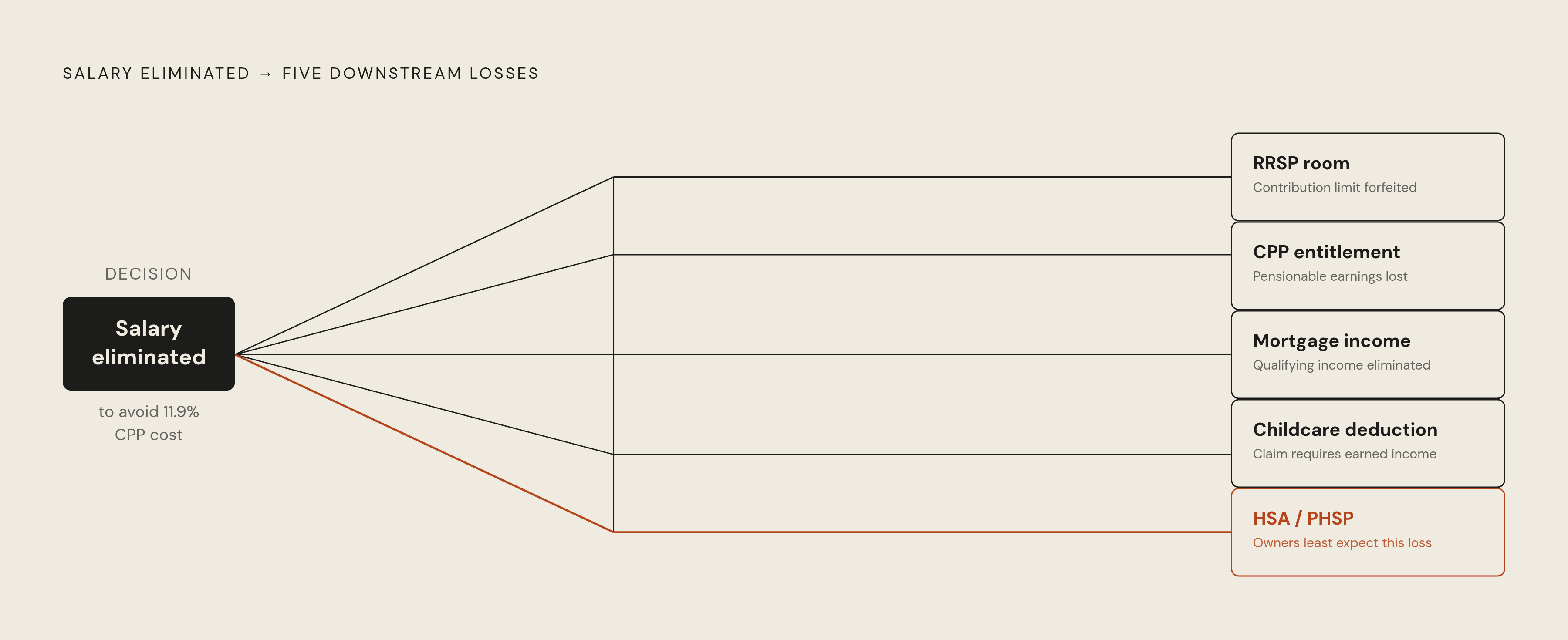
The clearest example of this is the salary-HSA dependency, and it's the one owners least expect. A purely dividend-based compensation strategy can create real questions about HSA eligibility. A shareholder receiving only dividends, with no T4 salary at all, may not meet the employment relationship requirements the CRA looks for when it decides whether a PHSP is actually a PHSP. An owner who drops salary entirely to avoid the 11.9% CPP cost doesn't just skip that one cost. That owner simultaneously forfeits RRSP room for the year, gives up CPP entitlement, loses mortgage-qualification income, loses childcare expense deductions, and puts HSA access itself at risk. One decision, made to solve one problem, touches four or five other things at once.
The salary-RRSP-CPP cluster works the same way, in a more predictable direction. Raymond James's 2026 analysis frames CPP as a guaranteed, indexed income stream, and many retired business owners come to value that because it arrives on schedule no matter what markets do that year. Whether the CPP cost is worth paying depends on the owner's age, their risk tolerance, and how much CPP entitlement they've already built up. Gondaliya CPA's 2026 guide lands on the hybrid approach most tax advisors recommend as a result: pay a base salary large enough to generate meaningful RRSP room and CPP credits, then layer dividends on top for flexibility.
The dividend-passive income dependency connects back to the SBD grind directly. Owners who let corporate earnings accumulate as investments, rather than paying themselves or deploying that cash in the business, risk crossing the passive income thresholds Cassar CPA's 2026 analysis lays out, the same thresholds that start eroding and eventually eliminate the federal Small Business Deduction. Paying health expenses through an HSA, rather than letting retained earnings build up and covering health costs personally out of that pool, keeps more corporate cash deployed in the business instead of sitting as passive investment income drawing down the SBD.
One more constraint shapes the mix for owners sharing compensation with family members. MaxRefund's 2026 breakdown flags that Tax on Split Income (TOSI) rules, expanded significantly in 2018, limit how much dividend income can be shifted to a spouse or adult child without triggering the top marginal rate on that income. That constraint matters specifically where the compensation mix includes a spouse or adult child as a shareholder, and it narrows the dividend-splitting flexibility that made dividends attractive to family-owned corporations before 2018.
Weighting the three tools by owner profile
A founder early in a company's life, with little retained earnings and a long runway before retirement, generally benefits from enough salary to start building RRSP room and CPP credits from year one, since room not built in an early low-dividend year is room that never comes back. An owner closer to retirement, with substantial CPP entitlement already banked and a corporation holding significant retained earnings, may lean harder into dividends while watching the passive income thresholds Cassar CPA's analysis sets out, so the SBD doesn't start eroding.
An owner with a spouse or adult child on the capitalization table needs to weigh the TOSI rules before assuming dividend splitting will work the way it might have before 2018. An owner applying for a mortgage in the near term needs enough T4 salary on record to qualify for lender income tests that dividends alone won't satisfy. And any owner who wants to cover medical, dental, vision, or paramedical expenses for themselves, employees, or dependants through the corporation, rather than paying those costs personally and claiming a fraction back through the METC, needs enough of an employment relationship on record, through salary, to keep a PHSP like an HSA recognized by the CRA.
None of the three tools works in isolation. Salary builds RRSP room, CPP entitlement, and mortgage-qualifying income, at the cost of payroll compliance and the 11.9% combined CPP rate. Dividends give you administrative simplicity and preferential personal tax rates, but they cost you RRSP room, CPP entitlement, and exposure to the passive income grind on retained earnings. An HSA, through a provider such as Frontier HSA, covers health costs as a deductible corporate expense rather than an after-tax personal one, but depends on the employment relationship that salary establishes. The right weighting between the three shifts with age, family structure, retirement timeline, and how much cash the corporation is holding onto, so it needs revisiting every year.
Sources
- Salary vs Dividends in Canada: Best Pay Strategy
- Salary, Dividends or Both? How Canadian Startup Founders Can Plan Owner Compensation - Gondaliya CPA
- Should Incorporated Professionals Pay Salary or Dividends? The 2026 Analysis for Ontario-Based Business Owners - Cassar CPA Professional Corporation - Accounting Firm Toronto