HSA Annual Spending Limits and Rollover Rules in Canada
Employer-set limits and strict 24-month expiry windows keep Canadian HSAs tax-qualified.

Canadian HSAs don't run on the same clock as RRSPs or TFSAs. No government body publishes a ceiling that ticks up every January, no universal number every taxpayer can look up. Instead, the CRA sets a standard, not a number, and leaves the dollar figure to the employer and whoever administers the plan. That one distinction changes how these plans get built, sold, and abused.
Most people's mental model comes from RRSPs and TFSAs, where a central authority sets one indexed limit and applies it to everyone equally. HSAs, technically Private Health Services Plans (PHSPs) in CRA language, don't work that way. The governing text is Income Tax Bulletin IT-339R2, plus the definition of "private health services plan" buried in section 248(1) of the Income Tax Act. "HSA" and "Health Care Spending Account" are just marketing labels for the same legal structure, taxed identically no matter which term is on the brochure.
That framing also clears up a mix-up that trips up anyone who's read American financial content. U.S. HSAs are personal accounts, owned by the individual, with their own contribution caps and investment growth. None of that applies here. A Canadian HSA is employer-funded, holds no personal balance, and never grows through investment. Since there's no ceiling handed down from government, the real design questions fall on the employer: what counts as "reasonable," and how does the rollover structure need to work to keep the plan tax-qualified at all?
What the CRA's "reasonableness" test requires from an employer setting a limit
The rule is easy to state and hard to nail precisely: the plan has to name a specific dollar limit per employee classification, and that number has to be reasonable given the employment relationship. No stated limit, no qualifying plan. Skip this step and the arrangement can't carry the "element of risk" the CRA requires (more on that below), and the whole thing gets reclassified as a taxable benefit.
The CRA never published an exact dollar figure, so practitioners lean on benchmarks built from years of filing and adjusting these plans. A typical annual contribution falls between $2,500 and $5,000 per employee. Plans pushing toward $15,000 without clear justification are the ones most likely to draw scrutiny.
Reasonableness also extends to who gets what, beyond just the dollar amount. It's about who gets what. Limits get set by classification (executives, senior managers, general staff, however the employer wants to slice it), not by individual, and people in similar roles with similar tenure need similar credits. One rule of thumb holds that the top classification's limit shouldn't run more than ten times the bottom classification's limit. Cross that ratio, and the plan stops looking like an employee benefit and starts looking like a payout built for the owner's chair.
That's the shareholder-benefit trap, and it deserves to be taken seriously rather than treated as a technicality. A PHSP has to tie benefits to employment. A plan that funnels money almost entirely to shareholders, without extending something comparable to arm's-length employees relative to their pay, risks reclassification as a taxable shareholder benefit under the Act. None of the salary-percentage figures floating around are statutory numbers. They're industry interpretation, built from watching what the CRA tends to accept. Anyone structuring a plan around them still needs a professional who files these things for a living to sign off before the limit goes on paper.
The element of risk: why the CRA requires HSA funds to expire
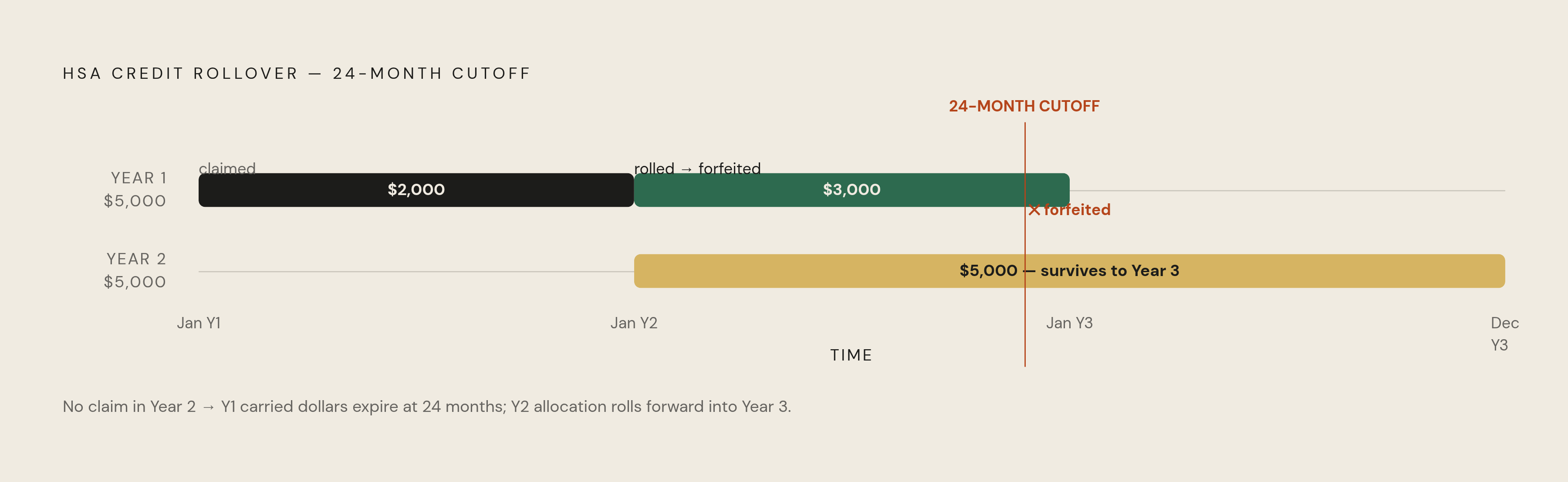
To qualify as a PHSP, a plan has to carry an "element of risk" under section 248(1). In plain terms: the plan names a benefit amount and a window to use it, and if the employee doesn't use it, they lose it. That forfeiture possibility is the risk the statute is actually pointing at.
Remove the expiry, and the legal character of the plan flips. An account that lets credits pile up forever, with no deadline and no chance of forfeiture, stops looking like an insurance-style benefit and starts looking like a personal savings account. A savings account isn't a PHSP, and crossing that line means every reimbursement loses its tax-free status and becomes taxable income to the employee.
Rollover caps and annual limits aren't a nice-to-have feature some providers bolt on and others skip for simplicity. They're structural. Load-bearing. Without them, the plan doesn't become less generous, it stops qualifying, full stop.
How the rollover works: the 12-month carry-forward and 24-month total window
The mechanics come down to two numbers. Unused credits carry forward for a maximum of 12 months, and the total window any dollar can stay alive is 24 months from when it was first allocated. Miss that window, and the funds are gone for good.
Forfeited doesn't mean the money vanishes, though. Every dollar in an HSA belongs to the employer the entire time, whether it's sitting unclaimed or getting paid out for a dental cleaning. When credits expire unused, they revert to the employer, who can withdraw them. The employee loses the chance to claim. The employer never loses the cash, and that asymmetry means the risk sits entirely on the employee's side of the ledger.
The CRA allows a carry-forward of unused credits, or a carry-forward of unclaimed expenses, but never both running at the same time. Rollover itself is optional, too. An employer can turn it off entirely and run a strict use-it-or-lose-it structure where anything unclaimed at year-end simply disappears.
Two examples make the math concrete. A manager with a $5,000 annual limit claims $2,000 in year one, leaving $3,000 to roll forward. Year two opens with $8,000 available (the fresh $5,000 plus the $3,000 carried). Claim nothing in year two, and the original $3,000 gets forfeited once it passes the 24-month mark, while the $5,000 from year two rolls into year three.
Scale that up. An incorporated professional with a $15,000 annual limit, covering a family of four, claims $6,000 in year one and rolls $9,000 forward. Year two opens at $24,000. They claim $8,000, which leaves $1,000 of the year-one rollover forfeited (past its window) and the full $15,000 from year two carrying into year three, which opens at $30,000. Some employers also offer a grace period after year-end to submit paperwork for expenses already incurred before the deadline, with 60 days being one common standard. That's a filing extension, not an extra carry-forward year, and the two get confused constantly.
How business structure changes what limits and rollover rules apply to the owner: business structure's effect on the owner's limits and rollover rules
Structure decides almost everything here, and incorporation is the clear winner. A corporation can set up a PHSP covering the owner, their spouse, and dependent children, even if the owner is the only person on payroll, as long as the owner is actually an employee drawing T4 income. Skip that step, and the CRA reclassifies the whole arrangement as a taxable shareholder benefit.
Single-person corporations hit a narrower wrinkle that can wreck a plan if nobody catches it ahead of time. A CRA technical interpretation addressing exactly this scenario, a self-insured HSA set up for a sole employee-shareholder and their family, concluded that this kind of arrangement would likely fail the "in the nature of insurance" test and wouldn't qualify as a PHSP at all. The CRA's position is that a sole shareholder-employee is seen as receiving the benefit as a shareholder rather than an employee, making it difficult to establish the arrangement as a qualifying PHSP. That's a real planning constraint that kills a lot of one-person incorporation strategies before they get off the ground. It's a real planning constraint that warrants careful review before any one-person incorporation strategy goes forward.
Sole proprietors face the tightest restrictions of the three, and honestly the least workable setup of the bunch. A proprietor with no employees can't set up a self-insured HSA for themselves, because the CRA sees no legal separation between the person and the business. Bring on at least one arm's-length full-time employee, though, and the door opens: the proprietor can offer that employee an HSA and claim a self-employed PHSP deduction for their own coverage. That deduction is capped tightly for unincorporated business owners, based on household composition and ages at the start of the insured period. Set that against the incorporated route, where the ceiling is just "reasonable relative to compensation," and the gap in flexibility is stark. Incorporation wins this comparison, and it isn't close.
Quebec treats employer HSA credits as taxable provincially, reported in Box J of the RL-1 slip. Employers with Quebec-based staff need to build that into how they explain the plan's tax advantages, since the federal tax-free framing doesn't hold at the provincial level.
Coverage under the plan generally ends when an employee leaves the company. Some plans build in a short run-out window (60 days is a common standard) so departing employees can submit claims for expenses incurred while still employed. There's no ongoing rollover once someone's off payroll.
What employees can and cannot claim within their annual credit: employee claims allowed and disallowed within the annual credit
The list of eligible expenses under an HSA matches the list used for the Medical Expense Tax Credit on personal tax returns, and it's deliberately broad. Prescription drugs, dental work, vision care, physiotherapy, chiropractic visits, mental health services, and well over a hundred other CRA-approved categories all qualify.
What doesn't qualify matters just as much, and this is where a lot of employers stumble. Cosmetic procedures are out. Over-the-counter items without a prescription are out. Gym memberships, bikes, general wellness purchases, anything that reads as lifestyle rather than medical, none of it belongs in an HSA. Those expenses belong in a separate Wellness Spending Account with different tax treatment, and mixing the two isn't just sloppy design, it threatens the plan's qualification. A PHSP has to keep all or substantially all (generally read as 90% or more) of its paid claims tied to medical expenses eligible for the tax credit. Dilute that ratio with non-medical spending, and the whole plan risks failing the test. Employers who blend wellness perks into their HSA to look generous are the ones most likely to get burned on this.
For employees with coverage through a spouse's group plan, sequencing matters more than people assume. Claim against the spouse's insured plan first, then use the HSA to cover whatever that plan didn't. Get that order backwards, and the result is HSA credits burned on something insurance would have paid anyway, money left on the table for no reason. International medical expenses are fair game too, as long as the expense qualifies under CRA rules and the claim comes with documentation showing the amount paid, converted to Canadian dollars.
Practical choices employers make when designing the plan's limit and rollover structure
Building a plan comes down to a handful of concrete decisions, and none of them have a single right answer, only tradeoffs.
Start with the annual credit amount, set by classification, not by individual. Most employers pay in the $2,500 to $5,000 range per employee, though incorporated professionals running their own plan sometimes push closer to $15,000. Whatever number gets chosen, it should get checked against the ten-to-one ratio between the highest and lowest classification. Cross that line, and the plan starts inviting exactly the kind of scrutiny that gets arrangements reclassified.
Then there's the rollover decision: on or off. Turning it on means employees carry unused credits forward for up to 12 extra months before the 24-month window closes, with the employer recovering anything that expires. Turning it off means simpler bookkeeping and a strict annual reset. Both are fully compliant. The CRA cares about the stated limit existing, not about whether rollover is part of the design.
Allocation timing is another lever employers should think through. Some release the full annual credit on January 1, giving employees maximum flexibility from day one. Others split it into quarterly chunks, which smooths out the employer's cash exposure across the year instead of fronting the whole amount at once.
Claim deadlines round out the list. A 60-day grace period after year-end for submitting paperwork on expenses already incurred is fairly standard across the industry, and there's little reason not to offer one.
Cost structure is where HSAs make their strongest case against traditional group insurance, and this is the part employers underweight. Administrators typically charge 8% to 10% of approved claims as an administration fee, and that fee is tax-deductible. The employer's net cost is just the reimbursed claim amount plus a modest fee on top, nothing more. No sunk cost in a quiet year, no premium bleeding out for coverage nobody used. That pay-as-you-go structure is the real argument for HSAs over group insurance for smaller businesses with unpredictable claims patterns. Group insurance charges the same premium whether employees file claims or not; an HSA only pays out when someone actually uses it. For a company with lumpy, unpredictable health spending, that difference alone should settle the comparison.