HSA for Incorporated Professionals — Physicians, Lawyers, and Consultants

A Health Spending Account lets your corporation pay your medical bills with pre-tax dollars instead of after-tax salary. I've watched enough physicians, lawyers, and consultants leave this on the table to know it's one of the most underused tools in the Canadian tax code, and I've watched just as many set one up wrong.
The terminology trips people up first. HSA, HCSA, PHSP: three names, same thing, and which one you hear depends entirely on which provider you're talking to. The legal anchor is section 248(1) of the Income Tax Act, which defines a Private Health Services Plan as a contract of insurance covering hospital and medical expenses. CRA requires that all, or substantially all, of the premiums (generally 90% or more) go toward expenses that qualify for the Medical Expense Tax Credit. No investment component, no contribution room carrying forward, no overlap with your provincial health plan. It's a reimbursement mechanism, plain and simple. You're not opening an account the way you'd open a TFSA; you're structuring a plan your corporation sponsors for its employees, one of whom happens to be you.
Why incorporated professionals are built for this
Dentists, physicians, consultants, IT contractors, financial advisors, realtors: anyone incorporated and drawing a T4 from their own corporation fits the profile. And the underlying math is almost insulting when you actually sit with it. High-earning professionals routinely pay medical costs out of pocket with after-tax personal dollars, which is close to the least efficient way to spend money that exists in the tax code.
The costs pile up faster than people expect, too. Dental work, vision correction, physiotherapy, mental health care, fertility treatments, prescriptions. For a family, that's several thousand dollars a year without trying hard.
Meanwhile, the corporation is sitting on money taxed at a fraction of your personal rate. Top-bracket professionals face personal marginal rates of 43 to 54%, depending on province, and every dollar of medical expense you pay personally instead of through the corporation costs you that difference in foregone savings. It doesn't matter if your corporation has 500 employees or one. A one-person professional corporation qualifies for the exact same structure, provided CRA's requirements are met. I call it the class-of-one advantage: solo doesn't mean second-tier here, even if CRA scrutinizes solo setups harder (more on that below).
What the tax advantage looks like in real numbers
The mechanism itself isn't complicated. The corporation pays the medical expense and deducts it as a business expense under paragraph 18(1)(a) and section 67. The employee-owner gets the reimbursement completely tax-free, no CPP or EI deducted, because subparagraph 6(1)(a)(i) excludes the benefit from employment income.
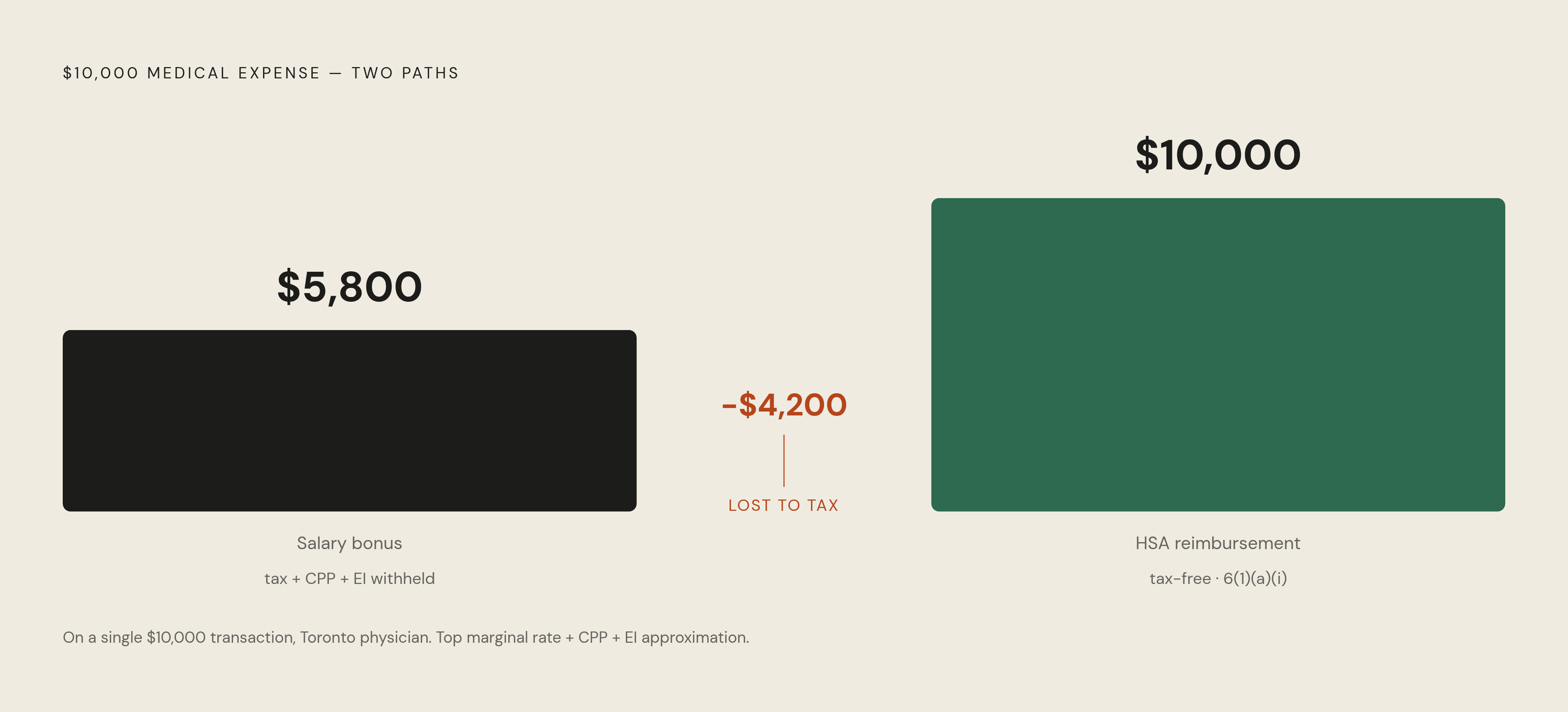
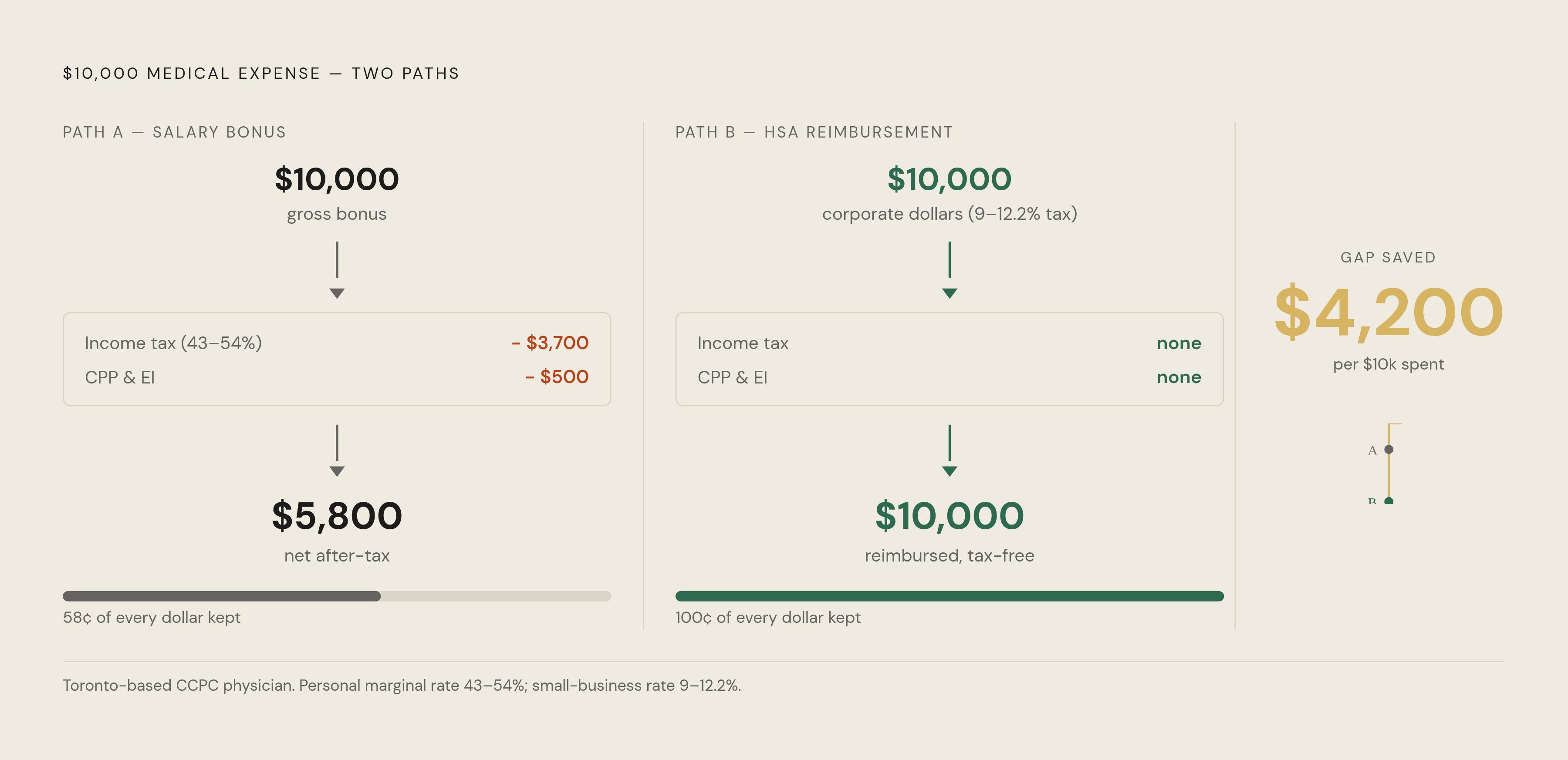
Here's what that means with real numbers. A Toronto physician taking an extra $10,000 as salary bonus nets roughly $5,800 after income tax, CPP, and EI. The same $10,000 spent on medical expenses, reimbursed through an HSA, arrives whole. That's a $4,200 gap, on ten thousand dollars, just from picking the right delivery mechanism instead of the wrong one.
Part of that gap traces back to something people miss entirely: a CCPC pays a combined 9 to 12.2% on active business income up to the small-business limit. So the money funding your HSA already got taxed once, at that low corporate rate, instead of at your personal marginal rate. The HSA isn't just dodging personal tax on the reimbursement; it's locking in the spread between the rate the money was earned at and the much higher rate you'd otherwise pay to pull it out personally. Across the cases I've seen, that works out to savings somewhere between 30 and 50% per dollar reimbursed, compared to paying the same bill with after-tax income.
The eligibility rules nobody reads until it's too late
The baseline is simple enough: the corporation needs at least one employee on payroll drawing T4 income. That employee can be you, which is exactly the part that makes solo professionals think this is easy.
It isn't, quite. CRA requires the plan to function as actual insurance, meaning there has to be a genuine element of risk assumed by the employer or administrator. It can't be a pass-through where your personal bills get relabeled as a corporate benefit and nothing else changes. The benefit also has to flow from your role as an employee, not from your position as a shareholder, and when one person holds both hats, CRA looks hard at which hat the money actually went to.
Sole proprietors have it worse. Without arm's-length employees, a sole proprietor can't use an HSA as a PHSP deduction vehicle at all, full stop. Incorporation isn't a nice-to-have here; it's the entry ticket.
Contributions need to be reasonable under section 67, though there's no hard dollar cap written anywhere in the law. What's reasonable depends heavily on salary and role, and there's no universally accepted figure or widely published guideline. Nobody's handing out a rule of thumb that fits every practice, and I'd distrust anyone who claims otherwise.
Where solo professionals get tripped up
This is the part that catches people off guard, every time. When you're the sole shareholder and sole employee of your own corporation, CRA's default assumption is that any benefit you get comes to you as a shareholder, not an employee. That distinction is not a technicality. A shareholder benefit is taxable under subsection 15(1), and that wipes out the entire advantage in one line.
CRA spelled this out in Technical Interpretation 2014-0521301E5: unless a sole shareholder-employee can show that employees at comparable corporations, doing comparable work, get comparable benefits, CRA treats the payment as a shareholder benefit instead of an employment benefit. Then in 2022, interpretation 2022-0928901C6 (dated May 3, 2022) went after cost-plus arrangements specifically. A plan that just reimburses a sole employee-shareholder's medical bills, with the administrator collecting cost plus a fee on top, doesn't qualify as a PHSP. There's no real insurance element in that setup. It's personal expenses run through a corporate pipe, dressed up.
The test comes down to whether real risk exists. If it's a near-certainty the employee gets their full annual allocation no matter what happens, the plan looks like sham insurance, not the real thing. Get this wrong and the reimbursements land back in your income under subsection 15(1); the tax advantage disappears, and you're staring at interest and penalties on top of it.
So what actually holds up? The corporation has to be a real operating business, not a holding company parked on investment income. The owner has to be an active employee, genuinely earning T4 income for actual work. And the plan needs documentation, specific and clear, framing it as employment compensation, not a shareholder distribution that happens to flow to someone who also works there.
For most physicians and lawyers, none of this is a stretch, since they're running active professional corporations and already drawing T4 salaries. The facts tend to support the structure on their own. Still, I'd rather pay a tax advisor to set this up properly than find out two years from now that my documentation doesn't hold up. This isn't a set-it-and-forget-it move. You build the paper trail as you go, or you don't have one.
What you can actually reimburse
The governing rule is almost too simple: if an expense qualifies for the Medical Expense Tax Credit, it qualifies under an HSA. The METC list is the master list, and that's the whole test.
For incorporated professionals and their families, the categories that matter most are dental (cleanings, fillings, crowns, orthodontics, implants), vision (glasses, contacts, progressive lenses, prescription sunglasses, and procedures like LASIK, which runs $2,000 to $4,000 per eye in Canada), and paramedical care (physiotherapy, massage, chiropractic, occupational therapy). Mental health services from licensed psychologists and counsellors count too, and 2025 updates expanded what's eligible here, telemedicine consultations included. Prescription drugs are one of the largest categories by dollar value. Fertility treatments generally qualify. Medical devices, hearing aids included, round things out.
None of this stops at you, either. Coverage extends to your spouse and kids, which is where the real value shows up for a family juggling ongoing dental, vision, or therapy costs.
What's excluded matters just as much: gym memberships, supplements without a prescription, cosmetic work like teeth whitening or elective surgery, anything over-the-counter without a script behind it. As of 2025, the METC threshold sits at a few hundred dollars or a small percentage of net income, whichever is less, worth knowing if you're claiming the METC personally alongside a corporate HSA, since the two interact.
Setting one up when you're a one-person shop
Start by confirming you're actually eligible. Active operating company, T4 salary, plan documented as employee compensation rather than shareholder distribution. Missing any of that, fix it before you do anything else.
From there, set an annual spending limit. No legislated ceiling exists, but it needs to be reasonable given your salary and role; most administrators can walk you through what's defensible based on cases like yours.
Bring in a third-party administrator. Don't try to run this yourself, since an outside administrator sitting at arm's length and processing claims independently is exactly what strengthens the insurance element CRA is looking for. When you're comparing providers, a few things separate the good ones from the rest: pay-as-you-go instead of prepaid credits, so you're not forfeiting unspent funds at year-end; digital claim submission, because nobody running a full practice has time for paper forms; and a fee structure you can actually see, instead of one buried under setup costs and annual charges. A percentage-based administration fee on approved claims, with no hidden charges, is a reasonable structure to look for, since it ties cost directly to actual use rather than to how big your plan looks on paper. Frontier HSA, a pay-as-you-go PHSP administrator for incorporated Canadian businesses, charges nothing until a claim is actually approved, no setup fees, no monthly premiums.
Once it's running, submit claims as they come in and keep every receipt. CRA can ask for documentation later, and a digital platform turns that into a five-minute task instead of a shoebox-of-paper problem, which is exactly what it sounds like when you're digging through a year of dental bills looking for one receipt. At year-end, the administrator's records back up the deduction on your corporate return, and your accountant will thank you for it.
Bring a tax advisor in from day one, especially if you're a sole shareholder-employee. The plan's documentation is your entire defense if CRA ever comes asking, and building it right at the start beats trying to reconstruct it two years later, after you've forgotten why you made half these decisions in the first place.