HSA Spending Trends Among Canadian Small Businesses
Employees prioritize dental, vision, and mental health when HSAs replace traditional group plans.

Canadian small businesses are spending their health dollars differently than the group insurance industry assumes. Employees tend to concentrate their HSA spending on dental, vision, and mental health services because provincial health plans leave those gaps wide open. That spending pattern tells employers something concrete about how to size and structure their own plans, and it starts with understanding why so many businesses walked away from traditional group coverage in the first place.
Why Canadian small businesses are moving away from traditional group plans
Industry forecasts from redhelm.ca put Canada's health benefit cost increase at roughly 8.3% in 2026. That's on top of premiums that already run steep for small teams: a company with ten employees paying $300 to $600 per person per month is looking at $36,000 to $72,000 a year, whether or not anyone actually uses the coverage.
That last part is the real sting. Group premiums get paid whether an employee files a single claim or fifty. An HSA flips that math: no claim, no cost. The employer only pays out when someone actually uses their allocation.
Cost is the top reason small businesses skip benefits altogether. A Blue Cross Small Business Benefits Study found 39% of small businesses name cost as their biggest barrier to offering coverage. Meanwhile, employees are telling a different story: employees consistently rank benefits among their top compensation priorities. That gap between what employers can afford and what employees actually want is exactly the space HSAs have moved into.
There's a productivity case too. Redhelm.ca estimates health-related absences cost Canadian businesses $16 billion a year. So this isn't just about trimming a line item on a budget spreadsheet, it's about keeping people at their desks.
The adoption numbers back this up. The 2024 Benefits Canada Healthcare Survey found 40% of Canadian employers now offer HSAs, up 10 percentage points since 2017. A separate, earlier dataset showed an even steeper climb, from 31% in 2017 to 57% in 2020, though that comes from a different survey population and shouldn't be read as a direct continuation of the same trend line. Either way, the direction is the same: this is a shift driven by employers solving an actual cost problem, not chasing a fad.
The tax structure that shapes how employers and employees think about HSA dollars
The Income Tax Act is what makes the HSA math work. The employer deducts the contribution as a business expense. The employee receives it completely tax-free, no income tax, no CPP, no EI.
Run the numbers on a real expense. Purposecpa.ca notes that someone paying $3,000 out of pocket for dental and vision work needs to earn roughly $5,000 pre-tax to cover it, once income tax eats into their paycheck. Route that same $3,000 through an HSA instead, and the corporation deducts it in full while the employee receives it tax-free. Nothing gets taxed twice, and nothing gets lost along the way.
Estimates from wellbytes.ca put the savings for incorporated professionals at 30% to 45% compared to paying for the same care out of pocket. Other sources put the range closer to 25% to 40%, depending on tax bracket, but the pattern holds either way: paying through an HSA beats paying with after-tax income by a wide margin.
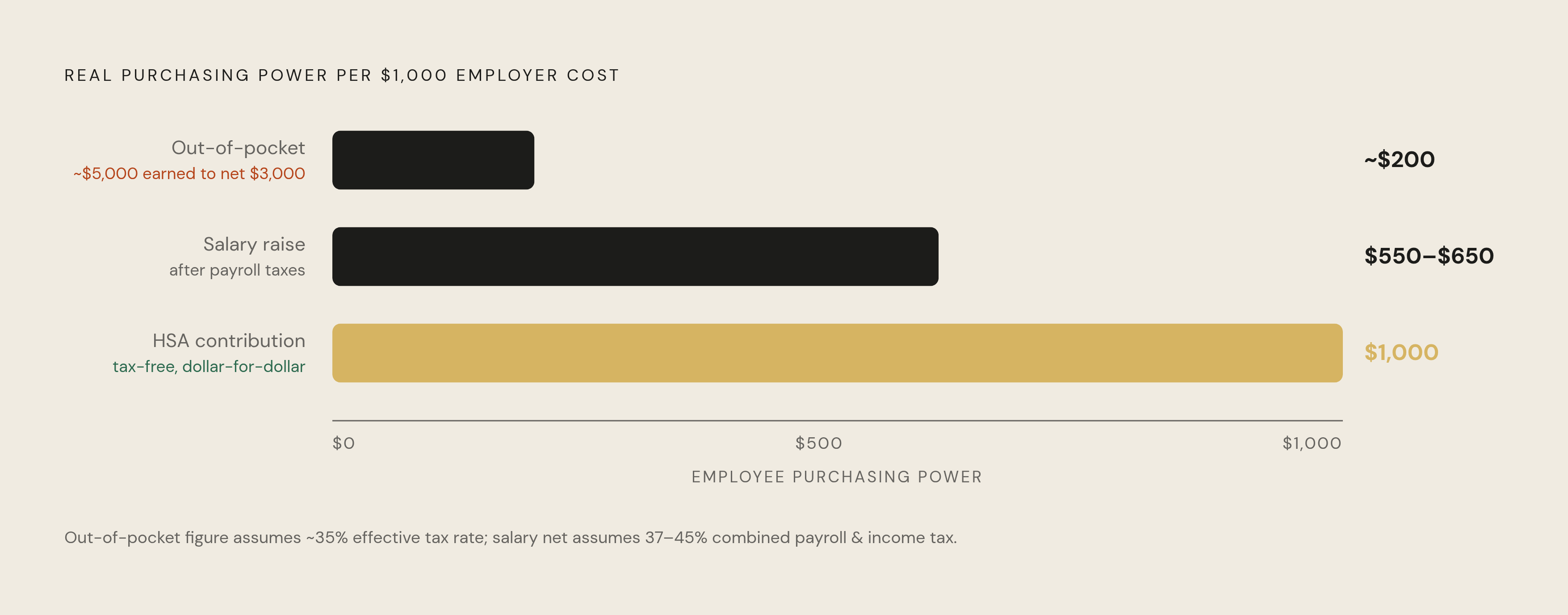
The comparison gets sharper when you set it against a raise. A $1,000 HSA contribution hands the employee $1,000 in real purchasing power. A table published by redhelm.ca shows a $1,000 salary bump, once it runs through payroll taxes, nets out to somewhere between $550 and $650 in the employee's pocket. That's the reason HSA dollars behave differently than salary dollars: employees have every rational reason to use the full allocation, because none of it gets clawed back by tax.
How much employers allocate, budget sizing in practice
The BBD HCSA Report, cited via zoebenefits.ca, puts most small businesses' spending between $1,000 and $2,500 per employee per year. Across all standalone HCSA groups, the average works out to $1,598 per member annually. Smaller employee classes, groups of one to four people, tend to run higher, closer to $2,500 on average.
Tiered allocations appear often in practice. One structure cited in a 2026 employer guide sets executives at $5,000, full-time employees at $2,500, and part-time employees at $1,000. That's not a formula every business needs to copy, but it shows how employers scale allocation by role rather than handing everyone the same flat number.
A notable share of standalone HCSA groups carry no other insured benefits. For those businesses, the HSA isn't a supplement, it's the entire benefits plan. That changes how employees treat it. When there's no backup group policy sitting behind the HSA, people spend those dollars with more care, and the claims data ends up reflecting real priorities rather than leftover budget.
Sizing isn't arbitrary, either. Shareholder-employees face a practical ceiling: allocations generally shouldn't exceed about 20% of the employee's T4 income, capped at $25,000 a year. Go past that, and the business risks drawing CRA scrutiny. That guideline is a compliance boundary.
Which expense categories get claimed most (dental, vision, and paramedical at the top)
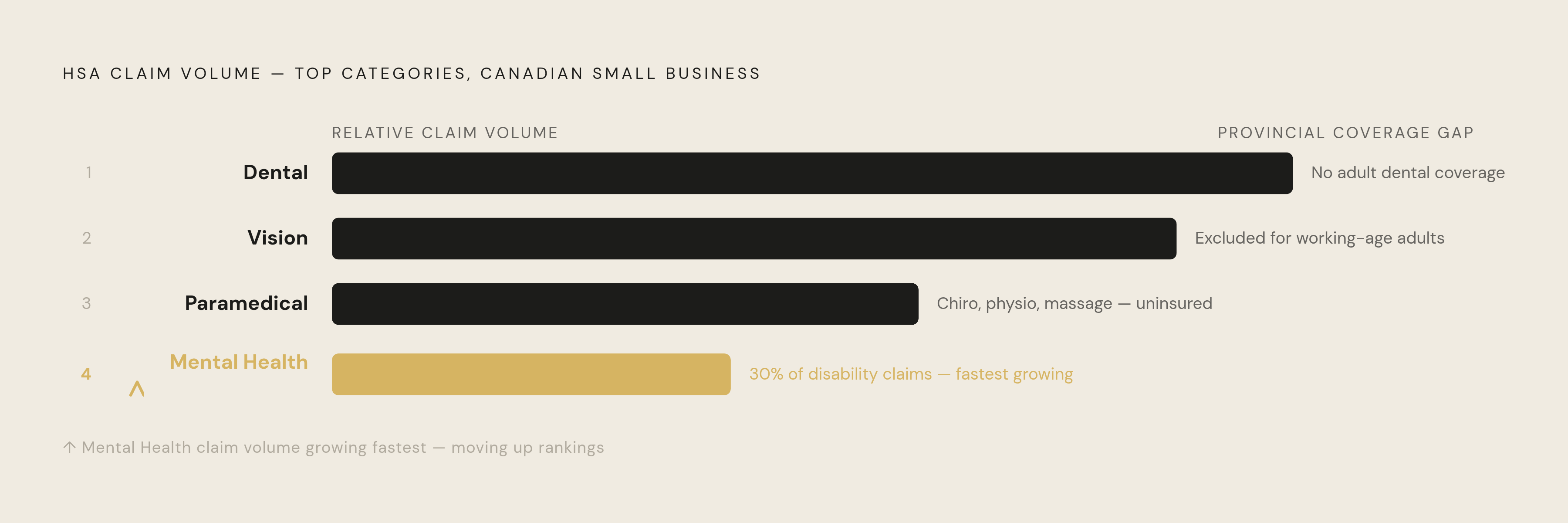
Dental and vision top the claims list across Canadian HSA plans, and it isn't close. Dental claims span the routine (cleanings, fillings) through to the expensive (crowns, orthodontics, implants). Vision claims cover glasses, contacts, laser surgery, and eye exams, services that provincial health plans mostly ignore for working-age adults.
The reason these two categories dominate isn't complicated. They're predictable. A family knows they'll need a dental cleaning and an eye exam this year, so they claim early and claim often.
Paramedical services form the next tier down. Chiropractic care, physiotherapy, registered massage therapy, naturopathy, acupuncture. Each requires the practitioner to hold a recognized professional designation in their province, but beyond that, the range of eligible care is wide.
Mental health is the category growing fastest, and by a wide margin. Eligible practitioners include provincially licensed psychologists, psychotherapists, and registered social workers. That growth tracks a larger crisis: redhelm.ca reports mental health conditions now account for roughly 30% of short- and long-term disability claims in Canada. Separately, bccabenefits.ca reports close to 40% of Canadian workers feeling burnt out, and 34% saying mental stress directly cuts into their daily productivity. Mental health coverage has become one of the most valued features in modern benefit plans, and the claims data backs that up.
Prescription medications and medical devices are eligible too, though they tend to ride alongside dental and vision claims rather than driving spending on their own.
Not everything qualifies, and the exclusions matter just as much as the eligible list. Gym memberships don't count. Neither do nutritional supplements without a prescription, cosmetic procedures like teeth whitening or elective surgery, or over-the-counter products bought without a prescription.
Line up the top three categories, dental, vision, paramedical, against what provincial health plans actually cover for adults, and the pattern is obvious: employees are claiming exactly what public coverage leaves out.
Mental health spending as a structural shift, not a temporary spike
Mental health coverage has moved from a nice-to-have add-on to a core piece of most Canadian group benefits plans. That's not a marketing shift, it's a response to demand that's been building for years.
The numbers explain why. Around 30% of disability claims in Canada now trace back to mental health, and 34% of workers say stress is actively cutting into their output at work. Those two figures point at the same underlying problem from different angles.
The HSA structure matters here. Traditional insurance plans cap psychotherapy sessions, often hard, with a per-year or per-session limit that runs out fast for anyone dealing with a real mental health need. An HSA doesn't impose that kind of category ceiling. A worker who needs twelve therapy sessions this year can put the bulk of their annual allocation toward psychotherapy instead of splitting it evenly across dental, vision, and everything else. Traditional group plans simply can't flex that way.
There's a payoff for employers here too. Redhelm.ca reports companies with comprehensive health benefits see up to 25% fewer sick days. That's the return side of the equation, and it's part of why employers who treat mental health as a retention and productivity lever, rather than an afterthought, tend to set higher allocations for their professional employee classes, in that $2,500 to $5,000 band seen in tiered plans.
How spending patterns differ between one-person corporations and small teams
For a one-person incorporated business, the owner is both employer and employee, and the HSA converts personal medical expenses into pre-tax business deductions. Every unclaimed dollar is a deduction left on the table, so spending tends to be thorough and deliberate. Nothing gets skipped because nothing goes to waste.
Scale matters here. For families with meaningful annual medical expenses, an HSA is often the cheaper option compared to group insurance. That's the range where the math clearly favors the HSA structure.
Small teams behave differently. With one to five arm's-length employees, the employer sets tiered allocations, but each employee spends their own share according to their own needs. Dental and vision still dominate, but the mix of paramedical claims shifts more with the makeup of the workforce, the mix of paramedical claims shifts with the specific health needs and demographics of the workforce.
Where standalone HCSA groups carry no other insured benefits, small-team HSA users are working with the whole plan, not a supplement to something bigger. Claims in that setup reflect necessity.
Satisfaction data backs up the value of that structure. A Sanofi Canada Healthcare Survey found 68% of plan members with an HSA said their plan met their needs, against just 49% among those without one. That gap affects morale and retention differently depending on team size: in a small team where every person's experience is visible to everyone else, dissatisfaction or satisfaction spreads faster and influences coworkers more directly than it would in a company of five hundred.
Some businesses split the difference: a basic group plan for core coverage, an HSA layered on top for the gaps. In that setup, HSA spending skews toward whatever the base plan caps or excludes outright, orthodontics, massage therapy, psychotherapy.
What HSA spending patterns reveal about gaps in Canadian provincial health coverage
Dental, vision, and paramedical care consistently rank among the top HSA spending categories, and none of the three get meaningful coverage under provincial health plans once someone ages out of childhood dental programs. That's not a coincidence.
HSA adoption is rising in large part because the space between what provincial plans cover and what people actually need keeps widening. The claims data maps onto that gap almost exactly.
Mental health makes the case sharpest. Psychological services receive limited coverage under most provincial health plans, and the growth in HSA mental health spending tracks the unmet need that provincial systems aren't fully addressing.
For employers, the takeaway is straightforward: when employees concentrate their spending in dental, vision, and mental health, they aren't being opportunistic. They're filling a hole that exists whether or not the employer does anything about it. An employer who understands that going in can size an allocation knowing the money will land on high-frequency, high-value care, not speculative extras.
What employers should consider when sizing and structuring their own HSA
Start with the claims data as a benchmark. If dental, vision, and paramedical care dominate, a $1,000 floor covers basic dental hygiene plus a visit or two to a physiotherapist or massage therapist. Push that to $2,500, and most employees get a fuller year of care covered.
Class-based tiers make more sense than a flat number across the board. Executives at $5,000, full-time staff at $2,500, part-time staff at $1,000, that's the structure laid out by Coastal HSA, and it works as a starting template rather than a rule.
For shareholder-employees, the 20%-of-T4 guideline, capped at $25,000, is a compliance ceiling, not something to build a plan around. Treat it as the line not to cross.
Deciding between a standalone HSA and a hybrid setup comes down to what the business actually needs. If predictable cost is the priority, standalone works fine. If the business also wants pooled coverage for a major medical event, pairing a basic group plan with an HSA top-up covers that gap, and in that setup, HSA spending naturally concentrates on whatever the group plan caps or leaves out.
Mental health deserves a deliberate line item in the budget, not leftover room after dental and vision get their share. Employers treating it that way are responding directly to the demand shift showing up in the claims data.
Administration costs run 5% to 10% per approved claim with most third-party providers; some charge a flat 8% with no setup or annual fee attached. Weigh that fee against what it buys: digital claims processing, CRA compliance handling, and direct EFT reimbursement to employees.
The core financial logic stays the same no matter how the plan is structured: if employees claim less than their allocation, the employer pays less. There's no premium sitting at risk the way there is with group insurance. Employers can afford to size allocations generously without exposing the business to unpredictable cost. And with a large share of employees saying they'd consider switching jobs for better benefits, a well-sized HSA isn't just a cost control tool, it's a retention one too.