Massage Therapy HSA Eligibility by Canadian Province
CRA's authorized practitioner list, not provincial regulation, determines HSA eligibility.
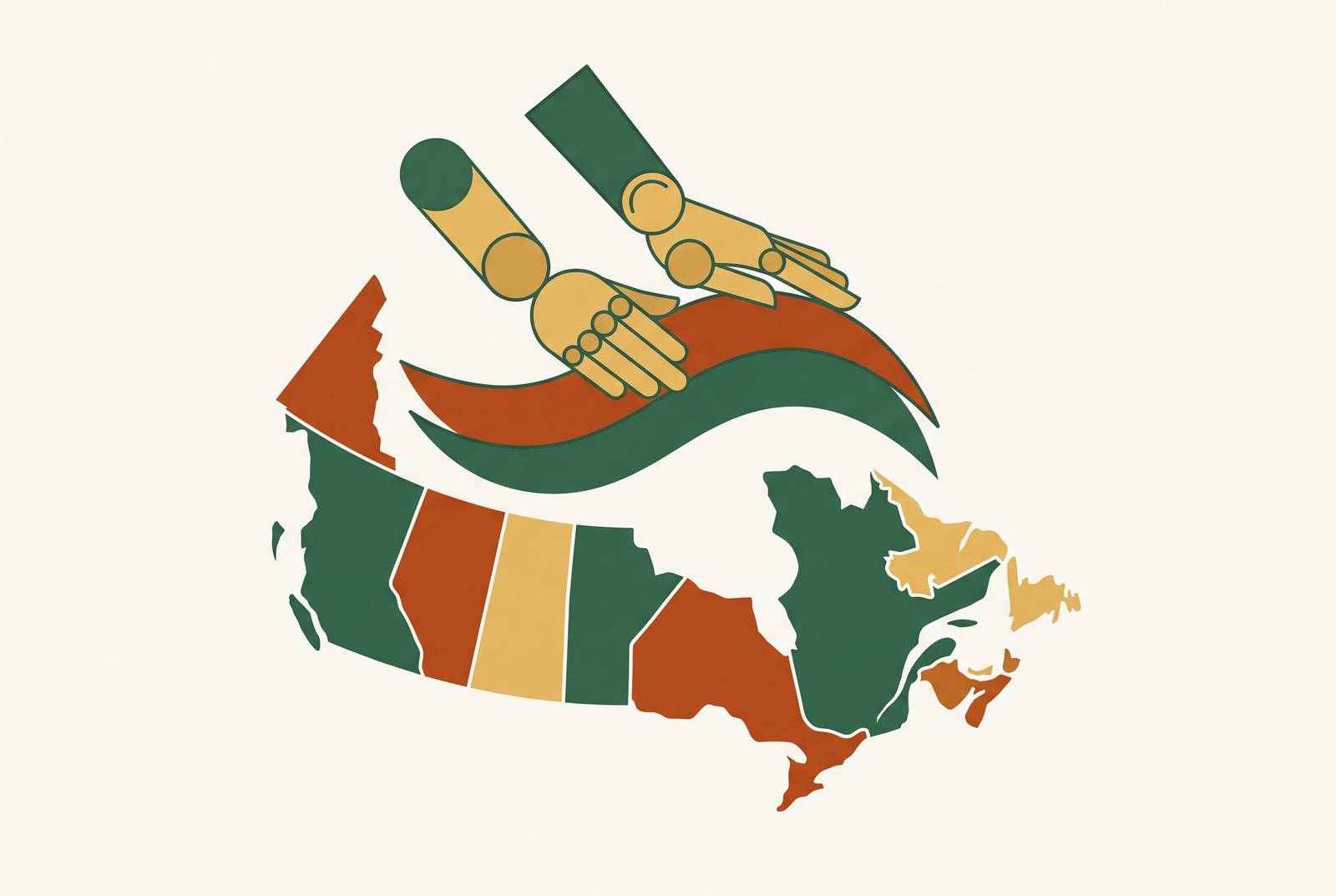
Whether a massage session qualifies for HSA reimbursement in Canada has nothing to do with how good the massage was, or even whether a doctor recommended it. It comes down to the province where the treatment happened and the CRA's authorized practitioner list for that province's massage therapists. That list, not provincial licensing status, is the entire test. Get the province wrong and the claim gets denied, no matter how legitimate the treatment was.
The deciding test for massage HSA eligibility: the CRA's authorized-practitioner list, not provincial regulation
A Canadian HSA is really a specific type of tax-advantaged health plan wearing a friendlier name. Its eligibility rules aren't invented by whatever provider administers the plan. They come straight from the Medical Expense Tax Credit (METC), the same federal framework that governs what counts as a deductible medical expense on a personal tax return.
To make that framework workable, the CRA keeps an official list of authorized medical practitioners, broken down by province and territory. For massage therapy specifically, that list is the whole ballgame. If massage therapists in a given province appear on it, the expense qualifies. If they don't, it doesn't, full stop.
Provincial regulation and CRA authorization are two completely separate processes, running on two completely separate clocks. A province can pass legislation, establish a college, require licensing, and build a real regulatory framework around massage therapy, and none of that automatically updates the CRA's list. The federal government has to act on its own timeline. So the map of "regulated provinces" and the map of "HSA-eligible provinces" often don't match, and that mismatch is the single biggest source of confusion for anyone trying to submit a massage claim.
Provinces where massage therapy is currently HSA-eligible: the five the CRA recognizes
As of now, massage therapy is HSA-eligible in exactly five provinces: British Columbia, New Brunswick, Newfoundland and Labrador, Ontario, and Prince Edward Island. Outside those five, the expense doesn't qualify, regardless of how the treatment was billed or who provided it.
Each of those five provinces has its own regulatory college overseeing massage therapists:
- British Columbia: College of Complementary Health Professionals of BC (formerly CMTBC)
- Ontario: College of Massage Therapists of Ontario (CMTO)
- Newfoundland and Labrador: College of Massage Therapists of Newfoundland and Labrador (CMTNL)
- New Brunswick: College of Massage Therapists of New Brunswick (CMTNB)
- Prince Edward Island: College of Massage Therapists of Prince Edward Island (CMTPEI)
PEI is the newest member of that group. Massage therapy became a regulated profession there in 2019, which brought the total count of regulated provinces to five, a number that advocacy groups have since pointed to as a benchmark when lobbying for further federal recognition.
New Brunswick deserves a quick note. Older reference material has occasionally listed NB as not authorized for HSA purposes, but that appears to be outdated information rather than a current gap. Anyone relying on NB's status for a claim should double check it against the CRA's current authorized practitioners page directly, since lists like this do get revised.
Provinces and territories where massage therapy is not HSA-eligible
The "not eligible" column includes Alberta, Manitoba, Nova Scotia, Saskatchewan, the Northwest Territories, Nunavut, and the Yukon. That's a lot of the country's landmass, even if it's not the majority of its population.
Alberta surprises people most. Massage therapists there are not on the CRA's authorized practitioners list, and no workaround changes that. Medical necessity and practitioner authorization are two different tests, and Alberta fails the second one regardless of what happens with the first.
Saskatchewan and Nova Scotia are more straightforward: massage therapy isn't on the CRA's authorized list in either province, so there's no foundation for HSA eligibility to build on.
Quebec falls into its own category. Massage therapy isn't on the CRA's authorized list there either, but Quebec also runs its own distinct tax rules through Revenu Québec. In certain circumstances, HSA reimbursements can trigger provincial tax obligations that don't exist anywhere else in the country. Any employer with employees in Quebec using an HSA should review the plan's structure with an advisor before assuming reimbursements work the same way they do elsewhere.
Manitoba in 2026: regulated but not yet CRA-eligible
Manitoba is the case study that makes the regulation-versus-recognition distinction concrete. On June 16, 2026, the Manitoba government formally designated massage therapy as a regulated health profession under The Regulated Health Professions Act, and set the wheels in motion to create the College of Massage Therapists of Manitoba.
Then on August 19, 2026, the province appointed a Transitional Council to build that new college and manage the handoff into full regulation. Massage therapists working in Manitoba don't need to do anything right now. The Transitional Council is responsible for developing profession-specific regulations and getting the college operational.
None of that means Manitoba massage therapy is HSA-eligible yet. Based on sources available at the time of writing, the CRA's authorized practitioners list has not been updated to include Manitoba RMTs. So Manitoba sits in a strange spot: fully regulated at the provincial level, but still in the "not eligible" column federally.
That gap isn't unusual, and it isn't likely to close overnight. Historically, the lag between a province regulating massage therapy and the CRA updating its list has run years, not months. Anyone administering benefits for Manitoba employees should treat massage therapy there as ineligible until the CRA list says otherwise, not the moment the provincial college opens its doors.
Requirements for a valid HSA claim for massage therapy: practitioner credentials, receipts, and rejection criteria
Eligibility isn't just about geography. Even inside one of the five eligible provinces, the specific service and the specific provider both have to check out.
The treatment has to come from a Registered Massage Therapist (RMT) who's registered with that province's regulatory college. A relaxation massage at a spa, performed by someone without RMT credentials, doesn't qualify, even if the spa happens to be located in Ontario or BC. The credential of the person doing the work matters as much as the province they're doing it in.
A handful of things get excluded even when the location and provider check every other box:
- Relaxation or spa-style massages, as opposed to therapeutic treatment
- Hot stone therapy or aromatherapy add-ons provided for general wellness rather than treatment
- Services performed by non-RMT staff at a clinic that also employs RMTs
- Products purchased at the clinic, like oils, tools, or equipment
Receipts matter just as much as the service itself. A valid receipt needs to show the practitioner's full name, their registration or licence number (the CMTO registration number, for instance, if the treatment happened in Ontario), the date of service, the type of treatment provided, the amount paid, and the clinic's name. Missing the registration number is a frequent reason a claim gets kicked back for follow-up or denied. It's a small line on a receipt, but it's the detail that turns a wellness expense into a documented medical one.
HSA reimbursement compared to claiming massage on a personal tax return
Claiming massage therapy through an HSA and claiming it through the METC on a personal return produce very different results, even for the exact same expense.
The METC only kicks in once total eligible medical expenses cross a threshold: the lesser of 3% of net income or a fixed dollar amount, which for the 2025 tax year was $2,759. Anything below that floor generates no credit. So someone who spends a modest amount on massage therapy across the year might get little or nothing back through a personal tax claim, simply because they never cleared the threshold.
HSA reimbursement skips that math. Every eligible dollar submitted gets reimbursed tax-free, calculated at year-end. For the business paying into the plan, the cost is generally deductible. For the employee or shareholder-employee receiving the reimbursement, it typically comes through without triggering a federal taxable benefit. For many small-business owners, an HSA claim beats waiting around for a personal METC deduction that might not even materialize.
There's also a practical, day-to-day difference. A personal tax claim requires tallying every medical expense across the whole year before anyone knows whether massage therapy specifically produced any benefit. An HSA claim doesn't wait for that. Each massage session gets reimbursed on its own, as it's submitted, without needing to know what the rest of the year's medical spending looks like.
A related but separate campaign: the GST/HST exemption push for massage therapy services
Massage therapy associations have spent years pushing for a GST/HST exemption on their services, and it's worth being clear that this campaign has nothing to do with HSA or METC eligibility. Winning that fight wouldn't change what's reimbursable through an HSA one bit.
The comparison practitioners point to most often is physiotherapy, chiropractic care, and osteopathy, which are treated differently for federal tax purposes. Massage therapy doesn't have that same federal exemption, despite doing similar therapeutic work.
The Canadian Massage Therapy Association made a formal application to the federal government in 2022, timed to follow PEI's 2019 regulation of the profession, which had brought the regulated-province count to five. That application didn't make it into the 2023 federal budget.
If the exemption eventually goes through, it would lower the out-of-pocket cost of booking a massage session. It wouldn't touch the separate question of whether that session can be reimbursed through an HSA. Both issues matter to RMTs and their clients, but they're moving down two completely different policy tracks, on two different timelines, decided by two different parts of government.
Province-by-province summary of current CRA status checks before submitting a claim
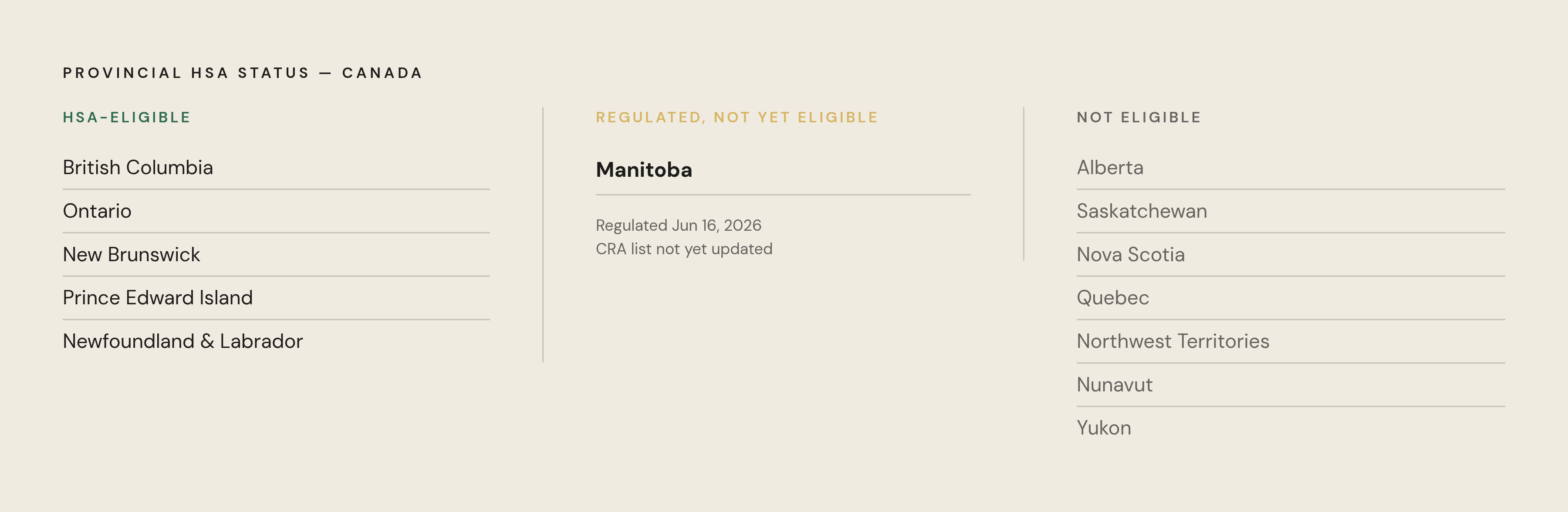
The full picture, province by province:
| Province/Territory | Regulatory Status | HSA Eligible | |---|---|---| | British Columbia | Regulated (College of Complementary Health Professionals of BC) | Yes | | Ontario | Regulated (CMTO) | Yes | | Newfoundland and Labrador | Regulated (CMTNL) | Yes | | New Brunswick | Regulated (CMTNB) | Yes (verify against current CRA list) | | Prince Edward Island | Regulated (CMTPEI) | Yes | | Manitoba | Regulated as of June 16, 2026 (transitional; college not yet established) | Not yet | | Alberta | Not regulated | No | | Saskatchewan | Not regulated | No | | Nova Scotia | Not regulated | No | | Quebec | Not regulated | No (additional provincial tax considerations apply) | | Northwest Territories, Nunavut, Yukon | Not regulated | No |
That table reflects sources available as of September 2026, and it's a snapshot, not a permanent record. The CRA's authorized medical practitioners list is the only source that actually matters here, and it can be revised without much warning. Before submitting any massage therapy claim, check that list directly rather than relying on last year's understanding of which provinces qualify.
Manitoba is the one to watch most closely. Its provincial regulatory designation is already in place as of June 2026, and a CRA list update reflecting that change could land at any time. Whenever that happens, Manitoba becomes the sixth eligible province, and the HSA landscape shifts again.
For small businesses and incorporated professionals in Canada looking to actually use this, the practical setup is an HSA plan where eligible massage expenses are submitted and reimbursed on a claim-by-claim basis. That structure turns eligible massage expenses into a genuine tax-free benefit, without carrying the overhead that comes with traditional group insurance premiums.
Sources
- Is Massage Therapy an HSA Eligible Expense in Canada? | Hiveworks
- Can You Use Health Spending Accounts for Massage? What Canadians Need to Know - RMT Clinic Network
- canada.ca
- Massage Therapy (RMT) Registration & CE/CPD Requirements in Canada | Province & Territory Lookup Tool
- mtam.mb.ca
- ctvnews.ca
- cbc.ca
- nhpcanada.org