How HSA Reimbursements Are Processed — EFT and Payment Timelines
EFT transfers typically take three to five business days after account verification.

HSA reimbursement is a simple mechanic with a lot riding on the details: you pay for a qualified medical expense out of your own pocket, then request a withdrawal from your HSA equal to that amount. That's the whole transaction, at least in concept. No claims adjuster reviews it, no insurer has to sign off before the money moves. The account holder decides when reimbursement happens.
That's a real departure from how insurance works. There are two ways to use HSA funds for an expense. You can pay at the point of sale with an HSA debit card, which skips the reimbursement step entirely, or you can pay out of pocket first and request the money back later. This piece is about the second path, because that's where timelines, documentation, and banking mechanics actually come into play. Since there's no underwriting gate and no insurer review, the wait to get your money back is basically an administrative and banking question, not an approval question. That distinction makes the timeline predictable, once you know what's driving it.
Qualifying expenses and the documentation you need before submitting
The IRS keeps this narrower than most people assume. Qualifying expenses are costs tied to the diagnosis, cure, mitigation, treatment, or prevention of disease. A gym membership might make you healthier in the abstract, but that's not what the rule is asking. The rule is asking whether the expense treats or prevents a specific medical condition.
Doctor visits, hospital stays, and lab work clear that bar easily. So do prescription medications, dental work like cleanings and fillings, vision costs including glasses and eye exams, mental health counseling, durable medical equipment like crutches or blood pressure monitors, and menstrual care products. Some categories sit in grayer territory. Massage therapy only counts if a doctor prescribes it for a specific condition, and nutritional supplements are generally excluded unless a doctor recommends them for something specific. That grey zone is why documentation matters as much as the category itself: the receipt alone rarely tells the whole story, and a doctor's note can be the difference between an eligible expense and a rejected one.
There's one rule with zero flexibility: the expense has to have been incurred after the HSA was established and funded. Pre-HSA expenses are never eligible, full stop. If you're digging through old receipts, check the date your account was opened before you get attached to reimbursing anything from before that.
The four reimbursement methods
Four paths exist to get HSA money into your hands, and they move at very different speeds.
The HSA debit card at point of sale is instant, and it skips the reimbursement workflow entirely. If the provider accepts it, this is the fastest option by definition, because there's no request to process afterward.
EFT, or ACH bank transfer, is the most common route for anyone who paid out of pocket. Online portal or in-app transfers work functionally the same way, just initiated through the provider's digital interface. Some platforms even let you move funds to another account at the same custodian, Fidelity to Fidelity for example, which can simplify things if you're keeping money within one ecosystem.
Then there's the paper check, mailed by the HSA provider, which is the slowest option by a wide margin. Mailing time and bank posting add on top of that, stretching the end-to-end wait to two or three weeks. If speed matters, and it usually does, a paper check is the one method built for patience.
How EFT reimbursement works step by step
EFT is where most people actually get their money back.
First-time users have to clear a setup hurdle before anything else can happen. Log into the HSA provider's portal, navigate to bank or payment settings, and enter the external bank account's routing and account numbers. From there, the provider runs micro-deposit verification. The account holder then has to log back in and confirm that exact amount to unlock EFT as a reimbursement method. Skipping this step means you can't request an EFT reimbursement at all, no matter how urgent the expense. It's the single most avoidable source of delay in the entire process, so get it done before you actually need the money, not after.
Once the bank account is verified, requesting reimbursement is straightforward. Log in, find "Submit a Claim" or "Reimbursement Request" (usually tucked under Transactions or Claims). Enter the expense details: date of service, amount, category, provider name. Upload the receipt or explanation of benefits, most platforms take PDF, JPG, or PNG, select EFT as the reimbursement method, and submit. Save the confirmation number. It sounds like a small thing, but if something stalls later, that number is what customer service will ask for first.
After submission, the administrator reviews the request against the linked bank account and the available HSA balance. HealthEquity publishes 3 business days as its standard processing window from submission, though its own help center also notes it can take up to 5 business days for funds to actually clear. There's no insurer approval gate anywhere in this step, it's purely internal processing followed by ACH initiation.
Then the money enters the banking network itself. Some platforms offer same-day ACH if you submit before a certain cutoff. Your own bank still has to post the credit on its end, and that posting time varies by institution, so even after the ACH clears the network, there can be a small additional lag before the balance actually reflects. Provider initiates micro-deposit verification: HealthEquity places a deposit of less than $0.50 within 2–3 business days. Once the provider initiates the ACH, standard network transit is 1–3 business days.
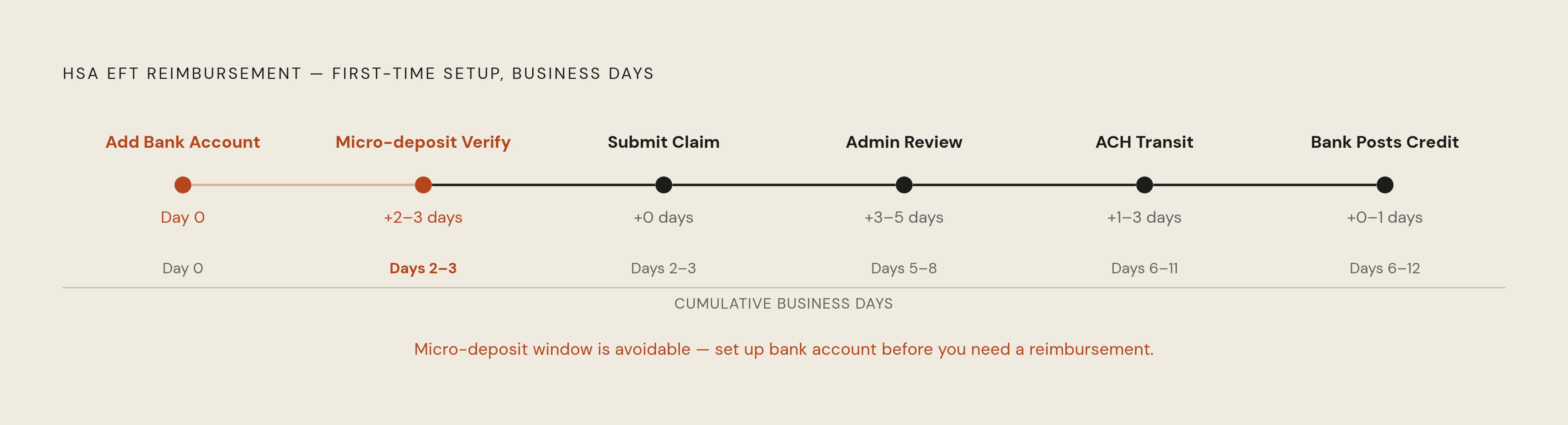
Realistic end-to-end timelines by provider and scenario
The commonly cited range for HSA reimbursement, across all providers and all methods, is 1 to 5 business days https://www.withflex.com/blog/hsa-reimbursement. That range is just not that useful on its own, because it flattens some real differences between providers and account types. It's just not that useful on its own, because it flattens some real differences between providers and account types.
Take HealthEquity as a concrete case. Adding it up, a first-time HealthEquity reimbursement paid by mailed paper check could realistically take 7–10 business days, or two to three weeks end-to-end, and incurs a $2.00 fee.
Fidelity splits into two very different stories depending on account type: paying at point of sale with an HSA debit card, which skips the reimbursement step entirely, versus paying out of pocket and requesting reimbursement later. But an invested HSA, like Fidelity Go, is a different animal entirely. Securities have to settle before funds can be sent, and that settlement can take up to 10 business days before the money even starts moving via EFT or check https://www.fidelity.com/go/hsa/faqs. That's not a minor gap, it's more than triple the wait of a cash-balance account, and it catches people off guard when they assume "HSA reimbursement" means the same thing regardless of how their balance is held. The standard published timeline is 3 business days from claim submission. HealthEquity also publishes an extended note stating it may take up to 5 business days for the reimbursement to clear the account. First-time EFT setup adds 2–3 business days for micro-deposit verification before any reimbursement can proceed. For Fidelity's cash HSA, EFT typically falls within the 1–3 business day ACH standard once initiated.
Common causes of delays
Top of the list: an unverified bank account. Without completing micro-deposit verification, no EFT can be initiated, period. This is the most avoidable delay in the entire system, and the fix is simple: set up and verify the bank account before you have a claim to submit.
Insufficient HSA balance is the second common trap. If a reimbursement request exceeds the available cash in the account, and the rest of the balance is invested, liquidation can add up to 10 business days before funds are accessible, the same Fidelity Go scenario mentioned above. Check the cash portion of the balance specifically before submitting a request.
Missing or incomplete documentation causes its own share of holdups. Providers can pend or reject a request if the receipt doesn't clearly show the date, amount, and provider name. Upload complete documentation at the time of submission rather than waiting for the administrator to ask for it later, that back-and-forth is often where days quietly disappear.
And then there's the one with no workaround at all: an expense that predates the HSA's opening. There's no appeal process for this, no documentation that fixes it. Verify the account's establishment date before submitting older receipts, because no amount of paperwork will make an ineligible expense eligible.
The no-deadline rule for intentionally delaying reimbursement
Here's a detail that changes how a lot of people should think about their HSA entirely: there is no IRS-imposed deadline on when a qualified expense has to be reimbursed. As long as the expense happened after the HSA was established, and the documentation is kept, reimbursement can happen years or even decades later.
Compare that to how FSAs work. Roughly half of FSA holders forfeit some portion of their contributions every year under the use-it-or-lose-it rule, and on average, people let more than $400 expire annually https://www.empower.com/the-currency/money/health-costs-reimbursements. Funds in an HSA carry no such pressure to spend them. It's a genuine structural difference, not a marketing point, and it opens up a strategy that FSA holders never get access to.
If you can afford to cover a medical expense out of pocket today, you can leave the equivalent HSA funds invested and let them compound tax-free instead of withdrawing right away. Years later, you submit the original receipt and pull out that same amount, tax-free, having captured however many years of growth in the meantime. The longer the deferral, the more that triple tax advantage compounds. A $500 dental bill paid in 2023 can be reimbursed in 2026 or beyond, tax-free, as long as the paperwork was kept the whole time. That's the account working exactly as designed, for the account holders patient enough to use it that way. It's the account working exactly as designed, for the account holders patient enough to use it that way.
Keeping records after reimbursement is received
Getting the deposit doesn't end the paperwork obligation, and this is where people get complacent. The IRS doesn't review HSA withdrawals at the moment they happen. The administrator tracks that a withdrawal occurred, but it typically doesn't verify what the expense actually was. Audit risk sits entirely with the account holder.
What should you hang onto? Itemized receipts, proof of payment, any explanation of benefits, and for borderline items like that prescribed massage therapy, a prescription or doctor's note. The general IRS guideline is to retain records for three years after filing, but for HSA expenses that haven't been reimbursed yet, the safer rule is to hold onto them until reimbursement happens, plus another three years after that. Given that reimbursement itself might not happen for years if you're deliberately deferring, that record-keeping window can stretch out a long time.
The good news is that storage isn't the burden it used to be. Most modern HSA platforms let you upload receipts directly into the portal, and scanning documents into a dedicated cloud or local folder works just fine, since the IRS accepts digital copies. There's no reason to keep a shoebox of paper for this anymore.
HSA administrators issue Form 1099-SA for distributions and Form 5498-SA for contributions each year, and this is worth checking annually. Reconcile those forms against your own records rather than assuming they match automatically. Administrators handle plan reporting as part of standard account maintenance, but the reconciliation itself is on you, and it's a quick check that can catch a discrepancy long before it becomes a problem at tax time. A withdrawal that turns out not to qualify, taken before age 65, carries a 20% penalty on top of ordinary income tax https://livelyme.com/blog/hsa-reimbursement-rules. That's not a small number, and the documentation habit matters as much as the timeline does. An ACH bank transfer typically takes 1–3 business days for HSA reimbursement https://www.withflex.com/blog/hsa-reimbursement. Direct deposit contributions typically post to a Lively HSA within 1 to 2 business days after initiation https://support.livelyme.com/hc/en-us/articles/30345455125787. File-based and dashboard contributions generally post to a Lively HSA within 2 to 3 business days after the file is processed or payroll confirmed https://support.livelyme.com/hc/en-us/articles/30345455125787. HealthEquity states you should allow 7–10 business days to receive a reimbursement check https://resources.healthequity.com/Forms/HSA_Reimbursement_Form.pdf. HealthEquity deducts a $2.00 fee for paper check reimbursement https://resources.healthequity.com/Forms/HSA_Reimbursement_Form.pdf.