EFT Reimbursement Speed and Settlement Options Across Small-Business HSA Platforms
Comparing reimbursement speed across HSA platforms reveals why some take days longer than others.
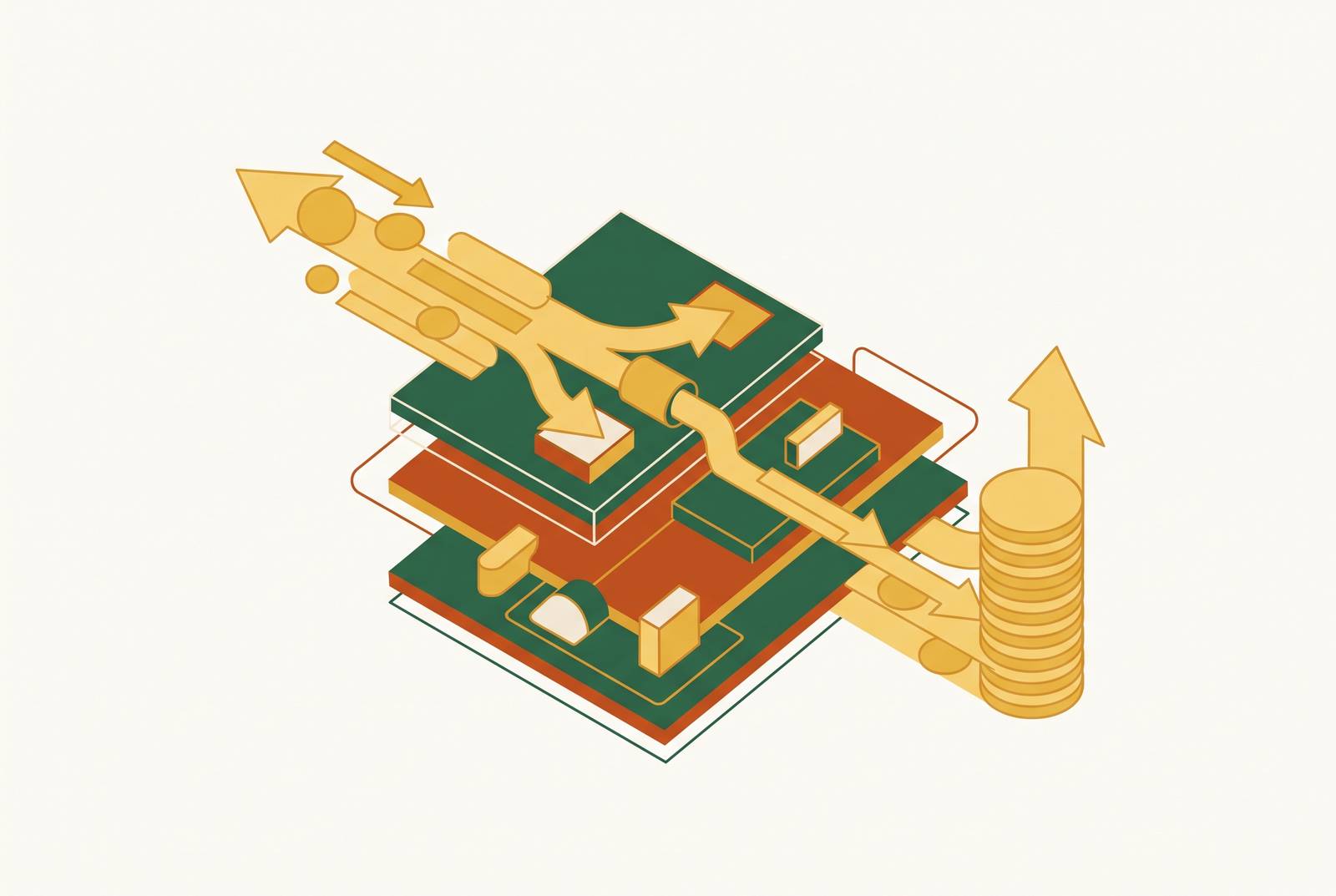
EFT reimbursement speed on an HSA is the output of four separate, identifiable variables: the payment rail used, how the claim gets reviewed, whether the bank account is verified yet, and whether the money sits in cash or in invested positions. Most people choosing a platform treat reimbursement speed as a given, something that just happens in the background, when in fact the gap between the fastest and slowest paths can run from same-day to more than a week. That gap changes how an owner-operator or an employee plans around a medical bill.
Across the named platforms, HSA Bank is the fastest on pure EFT settlement, completing transfers in roughly one to two business days with no incoming transfer fee. Fidelity HSA matches that 1-3 business day window when the balance sits in cash, but the timeline can stretch to ten business days if funds are invested, because trade settlement has to finish before the EFT can go out. HealthEquity typically wraps reimbursements within several business days and charges a modest transfer fee, with its strengths sitting in payroll integration and enterprise compliance rather than raw settlement speed. Lively closes the review gap with automated eligibility checks, so approved claims reach the payment rail in the same processing cycle without waiting on a human reviewer, which matters as much as the rail itself when most delays pile up at the review stage rather than the transfer stage.
Benepass's Benefits Benchmarking Report found that 61% of employers now offer an HSA. That puts most small employers squarely inside this system already, whether or not they've thought about how their platform actually moves money. If a small business has no dedicated HR team, it feels these delays more sharply, because no benefits staff stands between a confused employee and a slow reimbursement. Canadian small businesses running a Health Spending Account face the same variables, but under CRA rules instead of IRS rules, and Canadian EFT settles through Payments Canada's ACSS infrastructure on a broadly similar timeframe. Frontier HSA is a Canadian Health Spending Account administrator built for incorporated businesses, and it runs claim review and EFT disbursement through that same settlement infrastructure, so the variables below apply directly to how Canadian platforms structure their payouts. None of these four variables are mysterious. They can be named, checked, and compared before signing up for a platform, and that's the project of this piece.
The payment rail sets the floor for settlement speed
The rail a platform uses to move money sets the fastest speed it can offer, no matter how smooth everything else runs. Most HSA platforms still send reimbursements through batch ACH, which makes the 1-3 business day window the industry standard. It's a structural limit built into the rail, not a sign that a given platform is underperforming.
Across the market, platforms settle claims through a handful of methods: same-day or next-business-day internal transfer, standard ACH bank transfer running 1-3 business days, a mailed paper check that can stretch into many business days, or an immediate cash withdrawal at an ATM using an HSA debit card. Batch ACH dominates because it costs the least and works with nearly every bank, but it moves money in scheduled windows, not continuously. Submit a claim after a provider's daily cutoff, and the reimbursement waits for the next batch, adding at least one more business day before anything moves.
Faster infrastructure does exist. By mid-2026, the Federal Reserve's FedNow Service and The Clearing House's RTP network together reach a large share of U.S. financial institutions, and both can settle a credit push in under twenty seconds, any hour, any day of the year, including weekends and holidays. Both networks raised their transaction limits substantially in 2025. None of that changes the picture for most HSA account holders today. The infrastructure for near-instant settlement is live, but it hasn't become a standard feature that small employers can count on from their HSA platform. Once a platform does wire FedNow or RTP into its reimbursement flow, it will be able to offer disbursements in under twenty seconds, which would shrink the current 1-3 day standard to almost nothing. That's a shift to watch over the next few years, but it isn't a feature named HSA platforms offer right now. In the meantime, batch ACH keeps pausing on weekends and bank holidays in a way real-time rails don't, so the actual number of business days a claim takes can stretch depending on exactly when it's submitted.
Claim review method: automated versus manual
A claim has to clear review before the rail can move money, and the review stage often adds more delay than the rail itself. A claim stuck waiting on a human reviewer never reaches the payment rail at all until that review finishes, which adds the review layer's delay on top of whatever the rail itself takes.
You submit a claim correctly, and software checks it against eligibility rules in seconds or minutes. Once the claim is approved, the payment instruction fires in that same cycle. Lively is a concrete example of this approach working well: its automated review lets eligible claims move straight through without waiting on a person to look at them. Manual review runs differently. A human examines the claim, which typically adds one to two business days, and introduces the risk of a hold that has no fixed resolution date. Fidelity's model leans on a different structure entirely: the account holder initiates the reimbursement themselves, and Fidelity processes cash reimbursements by EFT in 1-3 business days. The review step there is effectively self-directed, which puts the responsibility for timing in the account holder's hands rather than the platform's.
These two variables, rail and review, have to be weighed together rather than separately. A platform with a fast rail but slow manual review can end up performing worse overall than a platform with an ordinary rail paired with fast automated review. Claim complexity plays into this too. A straightforward, clearly eligible expense sails through automated review on almost any platform. If a claim sits in a gray area, with eligibility that isn't obvious on its face, it triggers manual review no matter which platform handles it, so you should ask about manual-review turnaround time before you sign up anywhere.
You rarely see the choice between automated and manual review until you submit a claim, and that's exactly when it starts to matter. If you run a Canadian HSA platform serving incorporated small businesses, you can cut the processing stage from days down to minutes, because you automate eligibility checks against CRA rules instead of routing every submission to a person. Frontier HSA checks claims against CRA-eligible medical expenses automatically, so most straightforward claims clear review and reach the payment rail in the same cycle, and they don't sit in a queue for a reviewer.
Why the first reimbursement takes longer
Bank verification happens exactly once on any HSA account, but it lands at the worst possible time: the very first reimbursement, right when a new account holder has no track record with the platform and needs the system to work as advertised. Until the linked bank account is verified, the platform has no way to release EFT funds into it. Verification usually runs through micro-deposit confirmation or a real-time data check, either of which adds time before that first payment goes out.
This hits small-business owners hard when they're both the employer who runs the plan and the beneficiary who gets reimbursed, a setup common among incorporated professionals. The delay on that first cycle shapes how the whole benefit feels to everyone involved from that point forward. A high-value or unusual first claim can also trigger a fraud hold on top of the verification delay, adding time independent of anything related to the bank link itself. Once that first reimbursement clears, though, the verification step is done for good. Every reimbursement after it runs on the platform's normal rail-plus-review timeline, and no verification lag attaches to it.
The One Big Beautiful Bill Act (P.L. 119-21), signed into law July 4, 2025, expanded HSA eligibility, with guidance following in IRS Notice 2026-5. That expansion means more small employers will be bringing on first-time account holders in the years ahead, and first-time account holders are exactly the group most exposed to this bank-verification lag. This friction point will become more common across the market as adoption grows. Bank verification friction weighs heaviest on incorporated professionals and owner-operators, because they sit on both sides of the transaction, as employer and beneficiary at once. When platforms automate verification with real-time data checks instead of mailed micro-deposits, they cut this first-cycle delay substantially. Frontier HSA supports EFT reimbursements as soon as you link your bank details, so you should ask about the verification step directly before the first claim goes in.
The hidden delay when HSA funds are invested rather than held in cash
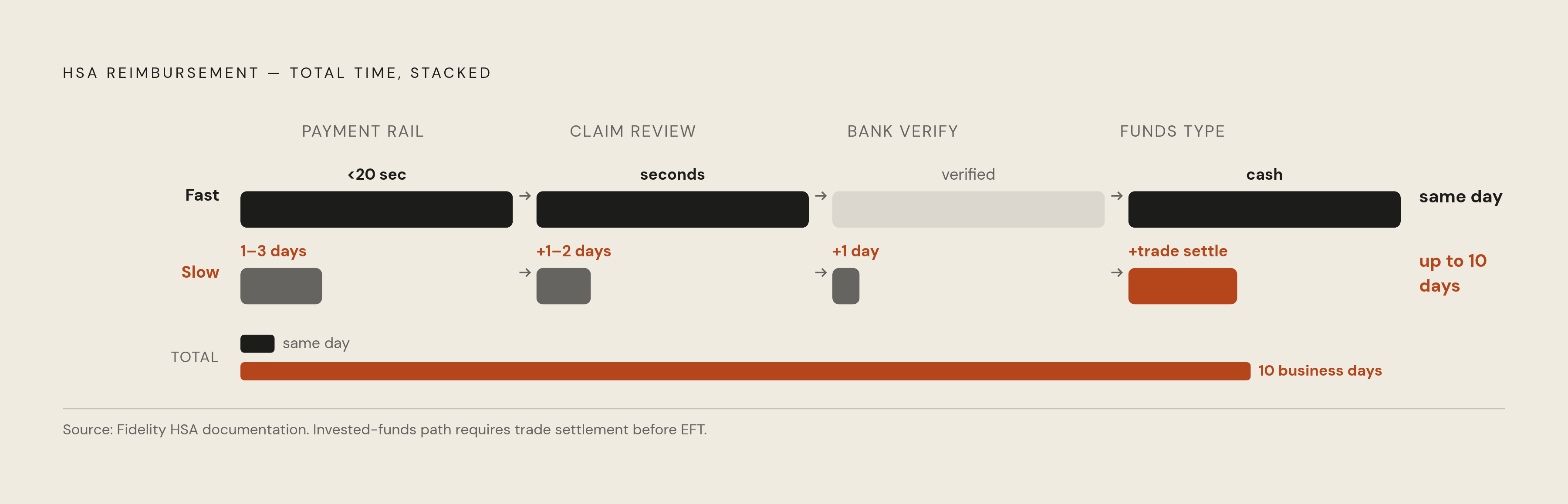
Moving HSA funds into investments adds a real cost in time whenever a reimbursement comes due, because the platform has to sell securities and wait for that trade to settle before it can even start the EFT. An account holder sitting in cash and an account holder sitting in invested positions can submit identical claims on the identical day and land on completely different payout schedules.
The sequence runs like this: request a reimbursement from an invested balance, and the platform sells the underlying securities, waits for the trade to settle, and only then initiates the EFT. That chain of steps can stretch the total timeline well past the standard 1-3 business day window most people expect. Fidelity's own HSA documentation spells this out directly: reimbursing from invested funds requires the proceeds to settle after the sale before an EFT, check, or account transfer goes out, and the whole process can run up to ten business days.
That creates a quiet asymmetry inside a single employer's plan. Two employees on the same platform, one holding cash and one holding invested funds, submit the same claim on the same day and get paid on two very different schedules. Most platform comparison guides and employer onboarding materials don't flag this up front. It tends to live buried in account documentation rather than get presented as a reimbursement-speed factor the way rail choice or review method does. For small employers, this matters most when employees are inclined to invest their HSA balances in the first place, a tendency Benepass's 2026 report ties to platforms that make investing easy to start. On those platforms, the real-world reimbursement timeline runs longer than the advertised EFT window suggests, simply because more of the money in the plan isn't sitting in cash.
How do HSA platforms compare on reimbursement speed for small businesses?
Every platform's actual reimbursement speed comes from how it mixes these four variables together: rail, review method, verification handling, and whether balances sit in cash or investments. The combinations differ enough from platform to platform that the same claim can come back on meaningfully different timelines depending on where it's filed.
Fidelity HSA charges no account fees, and it has no minimum balance requirement. Cash reimbursements move by EFT in 1-3 business days, but if funds are invested, the trade-settlement step described above can stretch the total to as much as ten business days. Reimbursement there is user-initiated rather than claim-triggered, so the investment delay is the main timing risk for account holders who actively invest their balance.
HealthEquity administers millions of HSAs and tens of millions of total accounts as of April 2025. Its transfer process typically wraps up within several business days, it carries a modest transfer fee, and it integrates well with payroll and HRIS systems, and its administrative fees stay competitive. HealthEquity's strengths sit in scale and enterprise-level compliance, and raw settlement speed isn't one of them.
HSA Bank completes transfers in and out of its accounts in roughly one to two business days, charges no fee on incoming transfers, and runs a straightforward electronic process. It's a simpler offering overall, and it trades some feature depth for a predictable, fast EFT cycle.
For Canadian small businesses, incorporated professionals, and eligible shareholder-employees, Frontier HSA administers Health Spending Accounts under CRA rules with EFT reimbursement built in as a core part of the product. It offers digital claim submission and tracking, covers a broad range of CRA-eligible medical expenses, and runs reimbursements on a pay-as-you-go model: an administration fee applies only on approved claims, with no setup fee and no annual fee. If you're an incorporated consultant comparing total cost on your annual claims, that pay-as-you-go structure means your cost tracks directly with approved claims, not with a flat premium charged regardless of usage. None of these platforms is the right answer for every business. Each one answers to a different priority: Fidelity to investment flexibility, HealthEquity to enterprise scale, HSA Bank to simple and fast EFT, Frontier HSA to a CRA-compliant, pay-as-you-go structure built for incorporated businesses north of the border.
When a slower-reimbursement platform makes sense
Fast reimbursement isn't automatically the right priority for every account holder. If you have the cash flow to cover medical expenses out of pocket, you can reasonably choose a platform built around investment growth instead of settlement speed, as long as you understand that trade-off going in.
No legal deadline requires you to get reimbursed from an HSA in the same year a qualified medical expense occurs, as long as you keep adequate records. That opens up a real strategy: pay the expense out of pocket today, leave the HSA funds invested and growing, and claim the reimbursement years later, tax-free, pulling out the compounded investment growth along with the original cost. HSAtrackr's 2025-2026 comparison lays out the scale of that effect. An account holder who maxes the 2026 individual contribution limit of $4,400 a year and earns a competitive return can build a materially larger balance over a 30-year horizon than someone on a lower-yield platform, a gap that speed alone can't close.
Speed and yield pull in different directions. A platform built around fast automated review and standard batch ACH rails doesn't necessarily offer the strongest investment options, and a platform built for investment growth isn't optimized to get money out the door quickly. The right choice depends on what the account is actually for. An employer setting up a benefit that employees will tap regularly for everyday medical costs should weight speed heavily, since slow reimbursement is what employees notice and complain about. If you treat the HSA as a long-term investment vehicle, paying smaller expenses out of pocket and letting the account compound, you can tolerate a slower reimbursement path in exchange for stronger growth. Both are legitimate ways to use the account. The platform that fits depends on which one describes the way the money actually gets used.