How Real Estate Professionals in Canada Can Use an HSA
Self-employed realtors can deduct up to $20,000 annually in medical costs through a corporate HSA.

Most Canadian real estate agents work as independent contractors under a brokerage, not as employees. That single fact decides how they can cover medical costs through the tax system, and it's why a Health Spending Account matters more to this profession than to someone punching in at a T4 job. Skip the HSA and default to personal insurance premiums instead, and money gets left on the table every single year, not once, but on repeat.
A self-employed real estate agent in Canada uses a Health Spending Account by establishing a Private Health Services Plan (PHSP) under Section 248(1) of the Income Tax Act through a licensed third-party administrator. The agent pays eligible medical expenses out of pocket, submits the receipt to the administrator, and receives a tax-free reimbursement that is fully deductible as a business expense for the corporation paying it. Sole proprietors face tight caps ($1,500 per adult per year) and must have at least one arm's-length employee on payroll to qualify; incorporated agents running a Personal Real Estate Corporation can access up to $20,000 annually by drawing a T4 salary from their own corporation and documenting the employment relationship formally. Whatever gets reimbursed through the HSA cannot also be claimed on the personal return through the Medical Expense Tax Credit.
No employer means no group benefits plan, no payroll deductions, no T4 from the brokerage at tax time. Realtors are self-employed by default: they owe their own income tax installments, their own CPP contributions, and once gross income clears a certain threshold a year, GST/HST registration too. Group insurance, the kind that covers a chunk of a dental bill or a kid's orthodontics, gets built around an employer-employee relationship. Remove that relationship, and the product isn't available in its usual form.
Personal health insurance still exists, but the premiums come out of after-tax dollars and don't write off against business income. Most realtors end up doing one of two things: eating medical costs out of pocket, or buying individual coverage that does nothing for the tax bill. Neither is a strategy. Both are what happens by default when nobody sets up the alternative, and that alternative is available to most people selling real estate in this country, not some narrow edge case reserved for the well-advised.
What an HSA actually is under Canadian tax law
An HSA, short for Health Spending Account, is a reimbursement arrangement. The CRA has a specific legal name for it: a Private Health Services Plan, or PHSP, with its foundation in Section 248(1) of the Income Tax Act. Some providers brand it a Health Care Spending Account, or HCSA. Same mechanism, different label; don't let the naming confuse the substance.
The mechanics are simple. Someone covered by the plan pays for a medical expense out of pocket, a filling, a pair of glasses, a massage therapy session, then submits the receipt, and the plan reimburses them. Done right, that reimbursement is fully deductible for the business paying it and fully tax-free in the hands of the person receiving it.
To count as a real PHSP, the vast majority of what the plan pays out has to go toward expenses eligible under section 118.2(2), the Medical Expense Tax Credit rules. That section covers dental work, vision care, prescriptions, physiotherapy, and dozens of other categories. The structural difference from group insurance matters here: insurance covers a fixed percentage of a specific treatment category, while an HSA hands the plan member a dollar credit to spend across any eligible expense, however they choose to allocate it.
None of this runs on the honor system. A third-party administrator processes the claims and keeps the plan inside CRA's PHSP rules, which is not something a business owner scribbles into a spreadsheet and calls compliant. Administration fees, usually a small percentage per claim, are themselves deductible.
How the tax math compares to just claiming the Medical Expense Tax Credit
Without an HSA, the fallback is the Medical Expense Tax Credit, and it needs saying plainly: the METC is a weak tool. Treating it as anything more than a consolation prize is a mistake. It lets a taxpayer claim eligible medical expenses above a threshold, the lesser of $2,759 (the 2025 figure) or 3% of net income, as a non-refundable credit. Credit, not deduction. The rate is 15% federally plus whatever the province tacks on, nowhere close to a dollar-for-dollar reduction of taxable income.
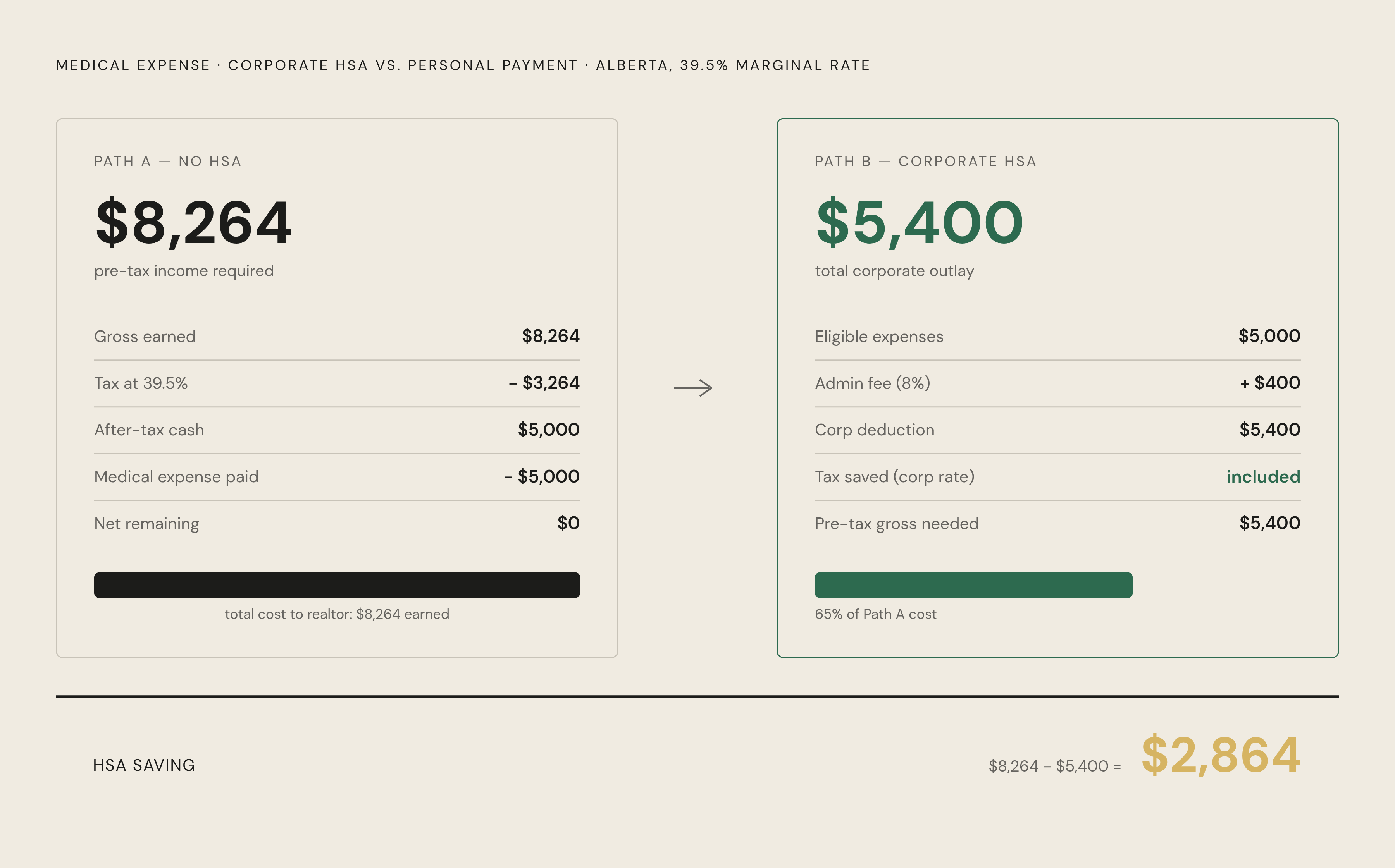
Take an incorporated Alberta realtor earning $100,000, sitting at a 39.5% marginal rate. Covering $5,000 in medical expenses with personal after-tax income means earning roughly $8,264 pre-tax first, just to net the $5,000. Run that same $5,000 through a corporate HSA instead, and it's a straightforward deductible business expense. Add an 8% administration fee, and the total corporate cost lands around $5,400, a savings of roughly $2,864 against paying out of pocket. The METC was never built to close a gap that size, and it doesn't come close.
One rule sits underneath all of this, and it's non-negotiable: no double-dipping. Whatever gets reimbursed through the HSA cannot also get claimed on the personal return through the METC.
How an incorporated realtor or PREC uses an HSA
In most provinces, Ontario, BC, Alberta, Quebec, Saskatchewan, Manitoba, and Nova Scotia among them, realtors can incorporate through a Personal Real Estate Corporation, or PREC. Commission income earned inside a PREC gets taxed at corporate rates, often well below the top personal rate, against a significantly higher top personal marginal rate. That gap is the headline reason realtors incorporate. The HSA is the quieter reason, and it's one a sole proprietor genuinely cannot replicate, no matter how the paperwork gets shuffled.
Getting there means the realtor actually has to be an employee of their own corporation, not just its owner: a regular salary and a T4 issued by the PREC, a formally documented PHSP set up through a third-party provider, and reimbursements that flow out of the corporation's account, never straight from the owner's personal funds.
The scale changes sharply once someone incorporates. A realtor drawing a T4 salary of $100,000 or more can expense up to $20,000 a year in health and dental benefits for themselves and their dependants through the HSA. Incorporated owners can even run what's sometimes called a "class of one" plan, covering just themselves and family, as long as it's structured properly. The CRA doesn't set a hard contribution ceiling, but amounts have to be reasonable; a common guideline keeps employer contributions under 25% of gross annual salary. Administration fees to run the plan are deductible too.
Strip away the mechanics, and the value proposition is this: a cost that used to come out of the realtor's personal, after-tax pocket now runs through the corporation, pre-tax.
What can a self-employed real estate agent actually do with an HSA?
A sole proprietor with no arm's-length employees can't set up a self-insured HSA and start deducting reimbursements. The CRA won't treat that arrangement as a genuine PHSP, full stop. Access requires at least one arm's-length employee on payroll; a spouse or family member only counts if the employment relationship is real, not a formality on paper drawn up to check a box.
When a sole proprietor does qualify, the benefits are capped, and capped low: $1,500 per adult per year, $750 per child. Getting there requires passing one of two income tests first. The 50% test asks whether at least half of total personal income came from the sole proprietorship, this year or last. The $10,000 test asks whether income from every other source combined stays under $10,000.
Most working realtors clear the 50% test without trying, since commissions dominate their income. The caps are the real sticking point, and pretending otherwise is a mistake worth naming plainly. For a realtor whose family runs up genuine annual bills in dental and vision care, $1,500 per adult doesn't go far. At this scale, the METC is often the more practical tool, thin as it is. Sole proprietor access to the HSA is real, but it's narrow, and that narrowness is exactly the argument for taking incorporation seriously.
The CRA compliance risks that can unwind an HSA if ignored
The CRA has already spoken directly to the riskiest version of this setup. Where a business owner sets up an HSA covering just themselves and family, with no arm's-length employees getting comparable benefits, the CRA is likely to reclassify the reimbursements as a shareholder benefit, not a legitimate PHSP payment.
The consequence isn't a slap on the wrist. Reclassification turns the reimbursement into a taxable benefit for the shareholder and, in the same stroke, a non-deductible expense for the corporation. That's double taxation, the exact opposite of what the HSA was supposed to accomplish.
Calling a plan an HSA doesn't make it one. This is where the whole structure quietly falls apart for people who treat it as a label instead of a legal arrangement with paperwork behind it. The plan has to actually meet PHSP rules: a formal written plan document instead of a handshake arrangement, reimbursements that flow through the corporation rather than around it, benefit limits that stay reasonable and consistent across similar classes of employee, and coverage that sticks to expenses eligible under section 118.2(2).
The fix is a licensed, third-party PHSP administrator, one that handles claims and keeps documentation to CRA standard. Self-administration is technically possible, but the documentation risk is steep. The downside of getting it wrong, a taxable benefit stacked on a non-deductible expense, dwarfs whatever fee gets saved by skipping a real administrator. The no-double-dip rule bites at the claim level too: any expense reimbursed through the HSA is off-limits for a METC claim on the personal return.
What kinds of medical expenses realtors typically run through an HSA
Broadly, anything eligible for the METC is eligible under a PHSP. That's a long list, but a handful of categories show up constantly for working realtors and their families.
Dental covers routine cleanings, fillings, crowns, orthodontics. Vision includes eye exams, prescription glasses, contacts, and procedures like LASIK, which typically runs $2,000 to $4,000 per eye in Canada. Prescriptions and ongoing medications fall in too, alongside paramedical services: physiotherapy, chiropractic care, massage therapy, psychology, naturopathy, acupuncture, provided the practitioner holds a recognized designation in their province. Mental health counselling from registered professionals counts, and so do medical devices, hearing aids, CPAP machines, orthotics, prosthetics, fertility treatment, ambulance costs, hospital care, medical travel, and prescribed medical cannabis.
What doesn't count: elective cosmetic procedures, over-the-counter vitamins and supplements without a prescription, general lifestyle spending that isn't medically necessary.
The breadth matters because realtors with families rack up real annual spending across these categories: dental cleanings for the kids, a new pair of glasses, a physiotherapy course after a bad back flares up. The HSA is built to absorb exactly that kind of recurring cost. A realtor already spending in these areas doesn't change behavior by setting one up. Only the tax classification of that spending changes.
How incorporation changes the HSA calculus for realtors weighing a PREC
For a realtor already running a PREC, adding an HSA is close to a formality, since the employment relationship with the corporation already exists. For a sole proprietor eyeing incorporation, the HSA is one of the few deductions the corporate structure genuinely unlocks, and no amount of clever structuring gets a sole proprietor there alone.
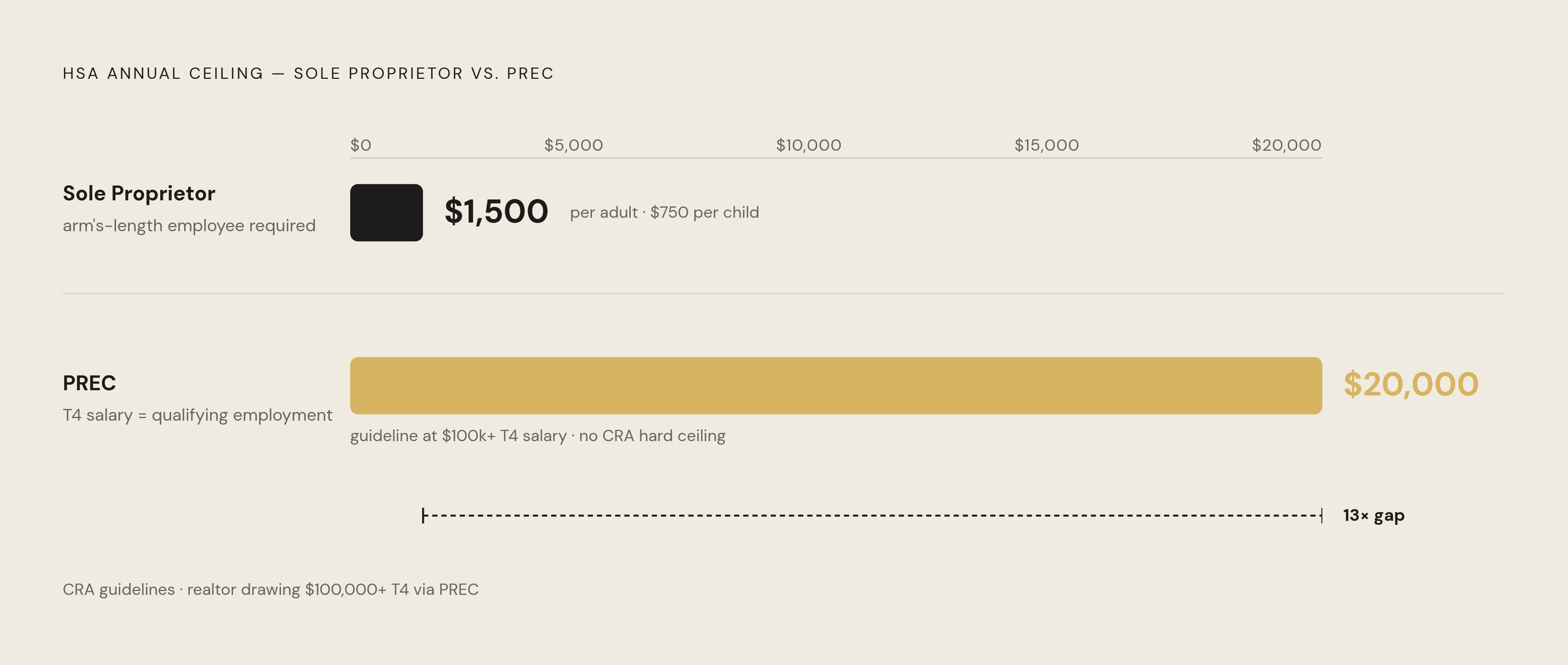
The gap between the two paths isn't marginal. A sole proprietor tops out at $1,500 per adult, needs an arm's-length employee on the books, and has to clear an income test just to qualify. A realtor drawing a $100,000-plus T4 salary through a PREC can access up to $20,000 a year for themselves and their dependants. For a household spending several thousand dollars a year on dental, vision, and paramedical care, that difference shows up clearly on the tax return; it is not a rounding error.
The HSA case for incorporating shouldn't stand alone, though. It sits next to the corporate tax rate advantage as one more reason on the pile, not a replacement for the main one. Anyone actually weighing this should total up what the household spends on medical and dental care in a typical year, run the pre-tax versus post-tax comparison at the real marginal rate, confirm the province permits PREC incorporation and check its specific rules, and set the HSA up through a licensed third-party administrator built to meet PHSP requirements. The employment relationship with the PREC, salary and T4 included, needs documentation too, not assumption.
Once that infrastructure exists, the ongoing work is small. A licensed PHSP provider runs the plan document, processes claims, and keeps reimbursements CRA-compliant. What's left for the realtor is submitting receipts and tracking how much room remains against the annual limit.