HSA Budget Planning for Seasonal and Variable-Revenue Small Businesses
Seasonal businesses need a revenue-tracking HSA strategy, not a fixed-paycheck playbook.

Most HSA advice assumes a paycheck that lands every two weeks like clockwork: contribute a set amount, hit the annual max, move on. Seasonal and variable-revenue businesses don't get that luxury, and the standard playbook actively backfires when 60 to 80% of a year's revenue lands in three or four months and the rest of the calendar looks like a cash desert. Cash flow trouble is widely recognized as one of the leading reasons small businesses fail, and seasonal operators feel that risk more acutely than almost anyone else. The fix isn't more discipline applied to the same framework. It's a different framework, one that makes HSA contributions track revenue instead of fighting it.
How HSA contribution rules actually work (and the one deadline seasonal owners must not confuse)

Health Savings Accounts are only available to people enrolled in a qualifying high-deductible health plan. For 2025, the contribution ceiling is $4,300 for self-only coverage and $8,550 for family coverage. Those numbers climb to $4,400 and $8,750 in 2026, and the self-only figure is already locked in at $4,500 for 2027. Account holders 55 and older get a catch-up contribution of $1,000, a number that hasn't moved since 2009, worth noting given how much everything else in health care has changed since then.
Every dollar counts toward the same ceiling regardless of source. Employee deposits, employer contributions, anything else that lands in the account: it's all one pool with one limit.
Here's the rule that trips up more seasonal business owners than any other: contributions for a given tax year are due by April 15 of the following year. Seasonal owners should confirm with a tax professional whether a filing extension affects this deadline, because treating it as flexible is how people get burned.
For a business earning most of its money in a three-month window, this means cash from that peak season has to be consciously set aside and held through the slow months, not spent down, so it's available to deposit by April 15 of the next year. That's a discipline problem as much as a math problem.
One thing works in favor of variable-income owners: HSAs roll over. Unlike an FSA, unused funds don't vanish at year's end. A lean year where the business only manages a partial contribution doesn't erase progress; it just adds a smaller amount to a balance that keeps compounding.
How business structure changes who can contribute what, and on whose return it lands
Entity type decides where the deduction lives and whether pre-tax treatment is even possible. Most owners skip past this part, and it's the part that costs real money when handled wrong.
Sole proprietors deduct their own HSA contribution on Form 1040, no itemizing required. That deduction never touches Schedule C, though. Contributions made on behalf of employees, by contrast, count as a regular business expense.
S-corp owners holding more than 2% of shares play by a different set of rules entirely. Under IRS guidance, employer contributions to that owner's HSA get treated as compensation. The owner then claims the deduction on their personal 1040, not through the business return.
Partnerships and LLCs work differently still. Contributions made on behalf of partners are generally treated as distributions rather than a partnership deduction. They show up on the Schedule K-1, and the partner deducts them personally.
Section 125 cafeteria plans let employees defer money pre-tax straight from payroll into an HSA. Owners generally can't use their own plan this way. Employees get that pre-tax treatment; owner-partners and sole proprietors mostly don't, and that gap surprises a lot of first-time owners who assume the perk applies to everyone on the org chart.
A sole proprietor has the most flexibility here, since contributions can be made on any schedule, any amount, right up to April 15. An S-corp owner's contribution runs through wage treatment, which moves to a different rhythm and needs to sync with payroll timing. This isn't a place to guess. Confirm the treatment for the specific structure with a tax professional before locking in a plan.
Setting a floor budget when you can't predict annual revenue
"Contribute as much as possible" is fine advice for someone with a stable salary. For a business that doesn't know in June what October's revenue will look like, that advice functions more like a wish than a plan, and following it anyway is the single biggest mistake seasonal owners make with their HSA.
A sturdier approach starts with a floor: the contribution amount the business can fund even in a bad year. The floor isn't the goal, it's the baseline the plan commits to no matter what happens. Everything above it gets treated as a variable layer, funded only when cash actually shows up.
Sizing the floor takes a specific kind of honesty. Look at the worst revenue year from the last three to five years, not the average and definitely not the best. Then figure out what predictable, baseline health costs the business, or its employees, actually face: recurring prescriptions, known chronic-condition expenses, that kind of thing. Set the floor to cover those, and nothing more ambitious than that.
The rollover feature does real work here. A year where the business only hits the floor doesn't waste what came before; the balance just keeps building at a slower pace. For businesses with employees, there's a trust dimension too, and it cuts a specific way: a benefit that shows up reliably at a modest level builds more goodwill than one that shows up big one year and disappears the next. Generosity that can't be repeated isn't generosity, it's a liability with good PR.
Aligning contribution timing with revenue cycles instead of the calendar year
Nothing requires self-employed owners or small businesses to contribute on a fixed payroll schedule. Contributions can happen monthly, quarterly, or as a single lump sum, any time before the April 15 cutoff. That flexibility is the whole game for a seasonal operator, and ignoring it in favor of a calendar-year mindset is the second big mistake, right behind chasing the annual max without a floor.
A landscaping company or a beachside retailer with a summer peak can hold that peak-season cash and deploy it as HSA contributions clear through the following April. A ski resort or a holiday-driven retail shop, running the opposite calendar, can wait and contribute in January and February when the bank account actually has money in it.
For a summer-peak business, the model looks something like this: during June through August, set aside a fixed dollar figure from revenue as the dedicated HSA pool. Don't touch that money for rent, payroll, or inventory during the slow season; treat it as already spent. Then contribute it in one or two batches sometime between September and the following April 15, once the actual cash position is confirmed.
There's a real tradeoff between lump-summing it and spreading it out. A lump sum early gives the money more time to grow tax-free inside the account. Spreading contributions across the peak-earning months matches cash availability more closely and cuts the risk of committing money that hasn't arrived yet. For most variable-revenue operators, periodic contributions during confirmed earning periods beat a big front-loaded bet made before the season proves out. The tax-free growth on an early lump sum sounds appealing until the season underperforms and that money was needed for payroll in October.
And again: April 15 doesn't move. Cash sitting in reserve past that date can't retroactively count toward the prior year, no matter how good the excuse.
How employers can structure HSA contributions for employees when payroll is uneven
Employers funding employee HSAs generally pick between two models. A lump sum at the start of the year is administratively simple but risky for a business whose revenue hasn't come in yet; committing to it before the season proves out is a bet on cash that doesn't exist yet. Variable periodic payments spread across pay periods match the employer's cash outflow to when money is actually available, which fits seasonal operations far better.
For businesses with seasonal staff, tying contributions to active employment weeks avoids overfunding benefits for someone who's only on payroll for twelve weeks out of the year.
Employer contributions are deductible as a business expense. In 2024, employers accounted for 24% of all dollars contributed to HSAs nationally, with an average employer contribution of $927 among those that contributed at all. That's not a small share, and it signals employers see real value in showing up here even when they can't max it out.
Consistency beats generosity, full stop. A modest, reliable floor contribution builds more trust than a bigger promise that might not materialize. Employees making their own contributions also need visibility into what the employer is putting in, so nobody accidentally blows past the combined annual limit. Section 125 plans, where they're set up, let employees defer pre-tax straight from payroll, which also trims payroll tax exposure for the employer on those amounts.
Outside the U.S., different rules and structures apply, and business owners operating across borders should verify how their specific jurisdiction handles employer health spending accounts before assuming U.S. HSA mechanics transfer.
Using HSA investment growth as a buffer against multi-year revenue volatility
HSA balances roll over indefinitely, and investment growth inside the account is tax-free. A short year doesn't erase the account's value, it just slows the climb, and most people leave this upside sitting untouched on the table.
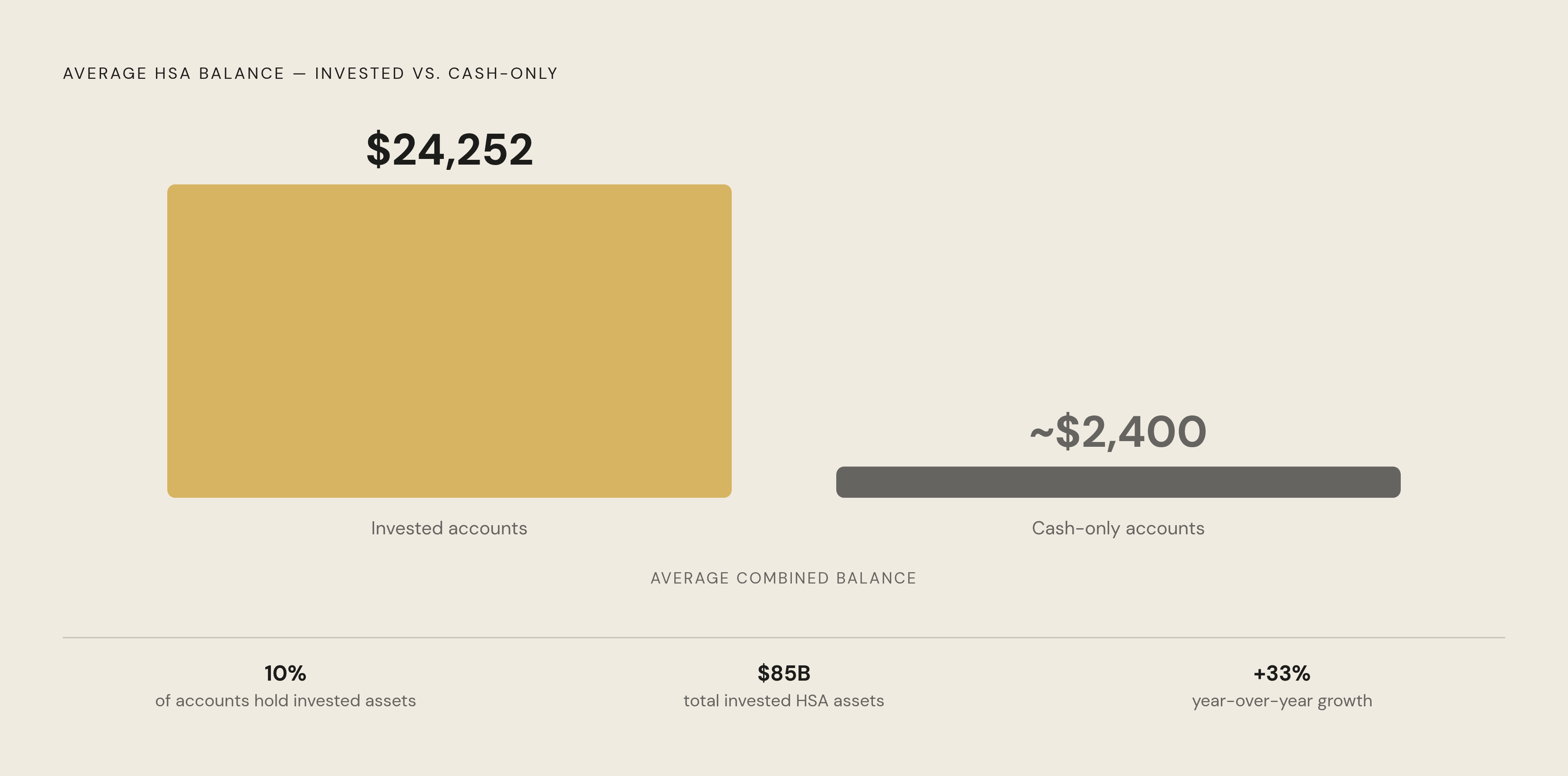
By the end of 2025, roughly 10% of HSA accounts held invested balances, and those accounts carried an average combined balance of $24,252, nearly ten times the average balance of an account sitting in cash without investments. Total invested assets across HSAs jumped 33% year-over-year, reaching approximately $85 billion by December 31, 2025. More account holders are starting to treat the HSA as a long-term asset rather than a spending account that just sits there waiting to cover a co-pay, and seasonal owners have more reason than almost anyone to join them.
For a variable-revenue owner, that reframe changes the whole strategy. In a strong year, pushing contributions closer to the annual max and investing whatever sits beyond near-term expected costs builds a reserve that can absorb a rough medical year down the line. In a weak year, medical expenses get paid from that accumulated balance instead of draining operating cash.
This is a different posture than what most employees take with their HSA, and it should be. A seasonal business owner has good reason to deliberately over-save relative to what the current year actually needs, using the account as a shock absorber against the unpredictable years still ahead. Getting the full benefit takes discipline, though: paying current eligible expenses out of pocket, when cash allows, keeps the invested balance growing instead of getting nibbled away one small claim at a time.
Practical steps to build a revenue-linked HSA budget before the plan year starts
Start with the revenue baseline. Use the lowest revenue year from recent history, not the average, as the floor for planning. This keeps the business from over-committing based on a year that might not repeat, which is exactly the mistake that sinks the whole plan by month eight.
From there, set the floor contribution: the minimum the business can fund off floor-case revenue without disrupting payroll or operations. Owner-only operations should size this against expected baseline medical costs and whatever contribution limit applies to their coverage type. Businesses with staff need to factor in the per-employee contribution times headcount, remembering that seasonal workers may not be on payroll the full year.
Map the revenue calendar next. Note which months historically bring in the bulk of the cash, and mark the contribution window running from the start of that peak season through April 15 of the following year. Flag that April 15 deadline clearly. It does not move with a filing extension, and treating it like it might is how businesses end up scrambling in mid-April with a half-funded account.
Earmark the money at the source. At the close of each peak-revenue month, move the designated HSA amount into a separate holding account, away from the general operating account where it can quietly get absorbed by slow-season bills.
Set a top-up trigger: a revenue threshold above the floor that automatically bumps contributions higher, toward the annual max. Something like, "if peak-season revenue clears this number, contribute this much more before April 15." Making the rule mechanical, rather than a judgment call made under pressure, keeps good intentions from evaporating once the season actually ends and the money feels like it's needed elsewhere.
Review the whole plan once a year, after the prior year's numbers are final, not mid-year in reaction to a slow month. Reactive changes made mid-season tend to lock in under-contribution habits that compound year over year. Before any of this gets set in motion, confirm how it plays out for the specific business structure with a tax professional. Deduction rules shift by entity type, and getting that wrong changes the real value of everything built around it.