HSA as a Recruitment and Retention Tool for Small Businesses
Small businesses can undercut bigger rivals by making HSAs their sharpest hiring tool.

Small businesses can't win a bidding war on salary. What they can win is the HSA fight: a health savings account paired with a high-deductible health plan that costs less to run than a traditional PPO while handing employees a real, growing financial asset. Most small employers still treat it as a niche add-on, something to bolt on once the "real" benefits are settled. For a company under 100 people, the HSA is the sharpest, cheapest lever available for both hiring and keeping people, and treating it as an afterthought is the single biggest benefits mistake a small employer can make right now.
Health benefits rank as the most valued non-wage benefit among employees; a large majority call them "very important" or "extremely important" in SHRM's 2024 Employee Benefits Survey. Research consistently shows a substantial share of workers are watching the job market or actively applying elsewhere at any given time. Benefits decide whether someone picks up the phone for a recruiter, and small businesses are losing that fight before it starts.
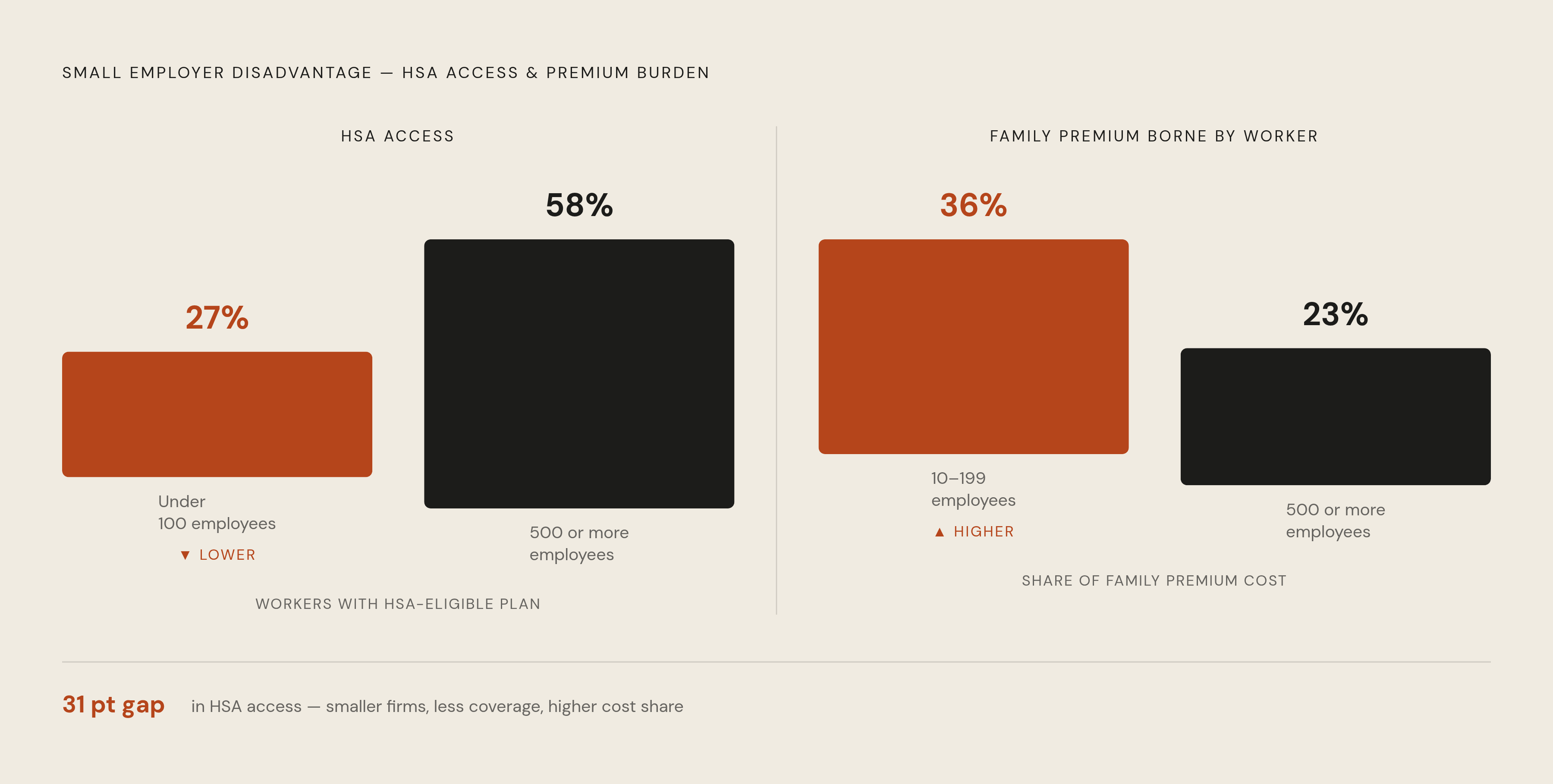
The gap is worse than most owners assume. Just 27% of workers at firms under 100 employees have HSA access, versus 58% at firms with 500 or more. Small firms also pay more for the privilege of falling behind: covered workers at companies with 10 to 199 employees contribute 36% of family premium costs, versus 23% at larger firms. An HSA is one of the only moves that fixes cost and competitiveness in the same motion.
What an HSA actually is, and how it differs from the benefits most small businesses already offer
An HSA is a personal, employee-owned savings account for qualified medical expenses. Once a dollar lands in the account, it belongs to the employee. No strings, no clawback provision waiting in the fine print.
To open one, the employee has to be enrolled in a High-Deductible Health Plan. For 2025, that means a minimum deductible of $1,650 for individual coverage or $3,300 for family coverage, rising to $1,700 and $3,400 in 2026. Contribution limits for 2025 sit at $4,300 individual and $8,550 family, combining whatever employer and employee put in together, climbing to $4,400 and $8,750 in 2026.
Compare that to a Flexible Spending Account, which most small businesses already run. FSAs come with a "use it or lose it" clock: spend the money by year-end or forfeit it. Unused HSA funds roll over indefinitely, and once a balance builds, it can be invested and grow like a retirement account. Nobody's rushing to buy new glasses in December to avoid losing the money. It's a balance worth holding onto and watching grow, and that difference alone should end the FSA-versus-HSA debate for most small employers.
The insurance-side difference matters just as much. With a traditional plan, the employer picks the coverage and absorbs whatever cost structure comes attached to it. With an HDHP-plus-HSA setup, the employer sets a contribution and stops there; nothing beyond that is the employer's problem. The employee decides how and when to spend what's sitting in the account.
One more detail worth sitting with: the account is portable. It belongs to the employee and travels with them if they leave. That sounds like bad news for retention. The reasoning behind why it isn't shows up later in this piece.
North of the border, the equivalent tool carries the same name, Health Spending Account, but runs on a different mechanism. Canadian employers set an annual budget, and employees submit CRA-approved medical expenses against it. No HDHP requirement, no premiums, no insurance policy underneath. Just different plumbing carrying the same core appeal: the employer controls the cost, the employee controls the choices.
How the HDHP-plus-HSA structure lowers costs for the employer without reducing the benefit's appeal
Here's what gets a small business owner's attention: switching from a PPO to an HDHP cuts the premium bill outright, and it shows up on the very first renewal. In 2025, average HDHP/Savings Option premiums ran $8,620 for single coverage and $25,379 for family coverage, against PPO averages of $9,818 and $28,272.
That gap is what funds the employer's HSA contribution, and it's what makes this structure work on a spreadsheet instead of a slide deck. Move to an HDHP, take the premium savings, put a real chunk of it directly into employee HSAs, and land at roughly the same total spend, or less, while adding a benefit people can see landing in their account every pay period.
There's no legal minimum on the employer contribution either. A business can start small, a few hundred dollars a year per employee, and build from there as revenue allows. The national average sits at $657 for single coverage and $1,203 for family coverage; that's a reasonable benchmark for "competitive" without needing to be the top bid in the market. Employer contributions are also 100% tax-deductible as a business expense, which sweetens the math further. A business with room can fund the full annual limit for an employee, a move that tells top candidates the company thought carefully about its benefits strategy rather than checking a box.
Here's the argument in one line, because it's the whole point: a small business can spend less on premiums than it did under a PPO while putting more real, spendable money into employee hands. That's a genuine upgrade in perceived value at equal or lower cost. Very few benefit changes pull off both sides of that trade at once, which is exactly why skipping this one is a mistake.
The tax advantages employees gain, and why they make the HSA feel like a raise
The HSA carries what's usually called a triple tax advantage, and it's the only savings vehicle in the U.S. tax code that stacks all three. Contributions go in pre-tax, the balance grows tax-free, and withdrawals for qualified medical expenses come out tax-free. A 401(k) offers a version of one or two of these breaks; an IRA offers another version. Nothing else combines all three at once.
Run it on an actual paycheck. An employee contributing the 2025 max of $4,300 in a 25% federal bracket saves roughly $1,075 in income tax alone, and a family maxing out at $8,550 saves around $2,138, all before payroll tax gets factored in. Contributions made through payroll deduction skip FICA too, so the employee avoids the 7.65% employee share on every dollar routed that way.
There's a retirement angle that lands especially well with a workforce further along in their careers. After age 65, funds can come out for any purpose, not just medical expenses; ordinary income tax applies to non-medical withdrawals, but there's no penalty. That makes the HSA function like a second IRA with better tax treatment baked into the medical side. Employees 55 and older get an additional $1,000 catch-up contribution on top of the standard limit, worth flagging directly to anyone in that age bracket during hiring.
Say it plainly to a candidate: this is a tax shelter that happens to cover healthcare, and most people interviewing at a small business have never been offered one before. That framing alone changes how the benefit lands in the room.
The tax savings employers rarely talk about, and why they should
Employers get a tax benefit here too, and it almost never comes up in benefits conversations. When an employee contributes through payroll deduction, the employer saves its matching share of FICA on every dollar. That saving doesn't show up on any benefits summary, but it's real money, and it scales directly with participation and contribution size.
Stack employer contributions on top, deductible as a business expense, and the cost advantage compounds. Small businesses weighing whether they can afford this should also check eligibility for the SHOP Small Business Health Care Tax Credit, which can cover a substantial share of employee premium costs, or a somewhat lower share for nonprofits.
Here's what that adds up to: a business that sets this up correctly is restructuring compensation so the real cost sits below the headline number. That argument works in two directions. Internally, it justifies the spend to ownership or a finance committee watching every line item. Externally, it tells candidates the business thought this through past year one, a signal that carries more weight than a benefit that looks flashy but gets cut at the next budget review.
Why an employer HSA contribution is a stronger retention mechanism than it first appears
A large share of employees say they're more likely to stay with an employer that offers health insurance at all. An HSA stacks another layer on top of that baseline, because it adds an accumulation dimension a standard health plan never has. Employees aren't just keeping coverage; they're watching a number grow.
Portability looks, at first glance, like it should undercut the whole argument. If the account and every dollar the employer ever put in belong to the employee and travel with them, what's stopping someone from grabbing the balance and walking? Nothing, and that's worth saying outright instead of burying it, because the trust signal it sends matters more than the theoretical risk. What actually keeps someone in the seat is simpler: leaving means losing access to whatever the employer contributes going forward. That's a real cost attached to walking out the door, and it grows every year the person stays.
Compare that to a 401(k) with a vesting schedule, where the employer match sits locked up for years. HSA contributions vest immediately, no cliff, no multi-year wait. An employee sees the value on day one, which matters enormously in someone's first six months, long before a retirement match would ever kick in.
There's a trust repair happening here too, easy to miss if you're not looking for it. FSAs trained a generation of workers to distrust spending accounts, because "use it or lose it" punishes anyone who can't predict a year of medical costs in advance. HSA rollover and investment features turn the account into something employees actually want to protect, rather than a chore they're racing the calendar to spend down. TriNet found a large majority of employees rate a competitive benefits plan as "very important" for retention, and the HSA feeds that perception directly, since its value compounds visibly the longer someone stays.
The Canadian model backs this up from a different angle. A Health Spending Account resets its budget annually, giving employees a recurring, yearly reason to stick around and use what's been allocated.
How the market is moving, and what it signals for small businesses that wait
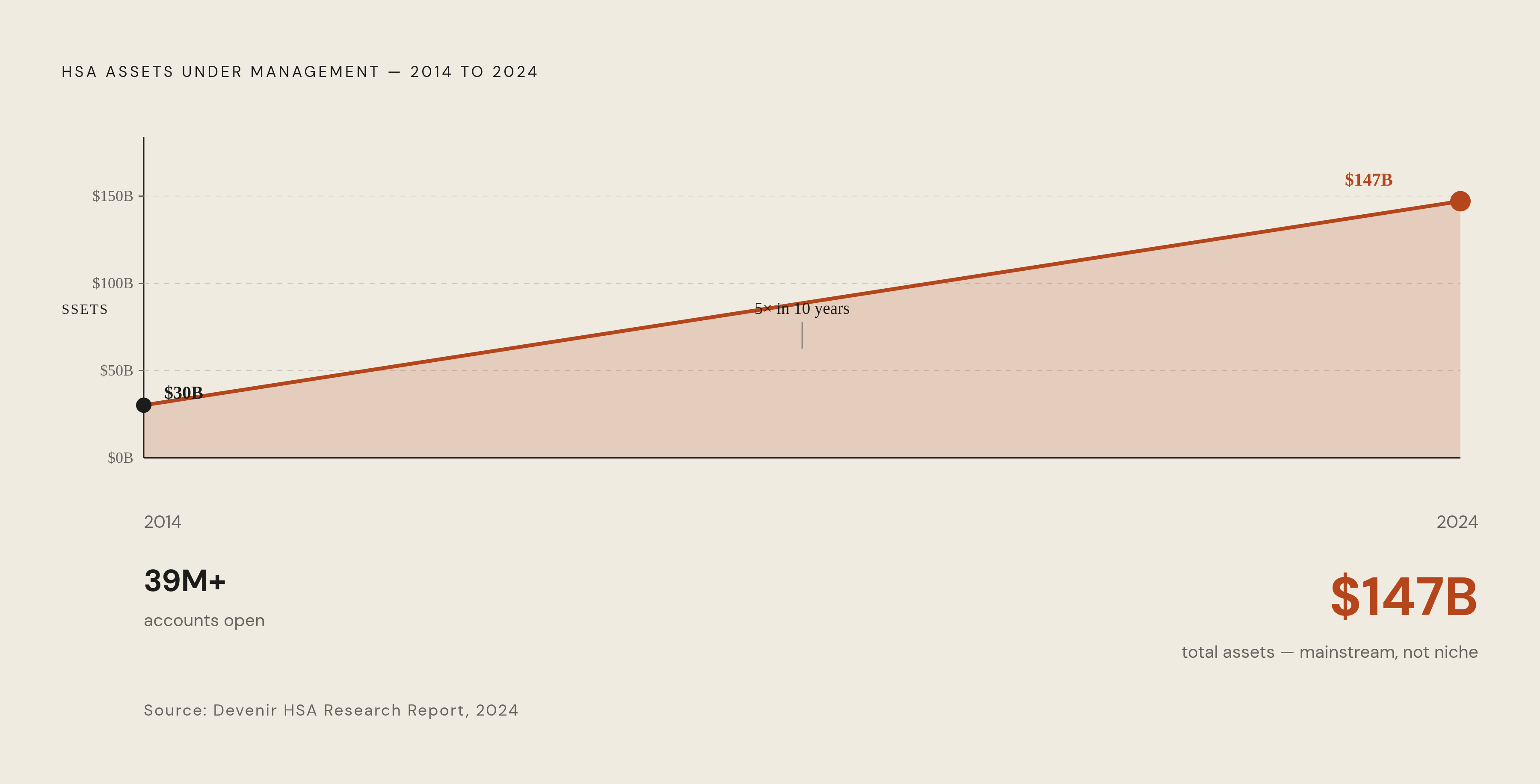
Total HSA assets hit close to $147 billion across more than 39 million accounts by the end of 2024, up from roughly $30 billion a decade earlier. That's a fivefold jump, and it signals mainstream adoption, not a niche perk for the health-conscious few. Enrollment in HDHP/Savings Option plans has grown steadily among covered workers in recent years. That trend matters directly for hiring: candidates who've had this setup before will expect it, or ask about it in the interview.
Here's the actual opening for a small business, and it won't last. More than 75% of companies offering health benefits in 2024 still didn't offer an HSA, per Voya, while Employers are increasingly shifting toward the flexibility HSAs provide. That gap is exactly where a small employer differentiates itself right now, while most competitors in its size class still haven't made the move.
That window closes as large employers keep normalizing the HDHP-plus-HSA package as a baseline. Every year a small business waits is a year the gap gets more visible, and harder to explain away, in every recruiting conversation it has.
How a small business should structure and communicate an HSA benefit to get recruiting and retention value from it
Set the contribution amount before launch, not after. Even a modest, consistent number, benchmarked against the national averages of $657 single and $1,203 family, signals commitment rather than reading as an afterthought.
Say it in dollars during hiring conversations. "We put $1,000 into your HSA every year" lands harder than "we offer an HDHP with an HSA option," a phrase most candidates won't fully parse on the spot anyway.
Onboarding is where the tax story has to get told, in specific numbers, not vague reassurance. Most employees, especially anyone who's never had HSA access before, don't grasp the triple tax advantage until someone walks them through the actual math. Once they do, the benefit's perceived value jumps well past the dollar figure alone.
Explain the rollover and investment features directly, too. Someone who understands their unused balance carries forward, and can be invested, treats the account like a long-term asset worth protecting, distinct from the old FSA habit of spending it down before December.
Be straightforward about the tradeoff baked into an HDHP: higher deductibles mean more out-of-pocket exposure before coverage kicks in. Employer contributions help bridge that gap, but employees deserve to hear the structure clearly, not discover it at the pharmacy counter.
Administration matters more than most employers expect. The more friction someone hits filing a claim or checking a balance, the less they value the whole benefit, no matter how generous the contribution is. Digital claim submission and simple annual reporting remove most of what causes people to tune the benefit out.
Revisit the contribution every year. IRS limits keep climbing, reaching $4,500 individual and $9,000 family in 2027, and even a small annual bump in the employer's number is a cheap way to show the team this isn't a one-time gesture.
North of the border, the mechanics differ but the discipline holds. A Health Spending Account run through a pay-as-you-go administrator skips fixed premiums entirely: the employer sets an annual budget, employees submit CRA-approved expenses digitally, and the business pays only against approved claims, often through a flat administration fee that replaces insurance overhead with predictable, transparent cost, Frontier HSA, a pay-as-you-go Health Spending Account administrator built for incorporated Canadian businesses that charges no setup fee and collects only an 8% administration fee on approved claims, is one such option. For incorporated professionals and shareholder-employees in Canada, an HSA also converts personal medical expenses into a deductible business expense, a distinct value proposition worth raising in the right conversation.
Whichever side of the border the business sits on, the principle holds. This benefit sells itself when an employer says the number out loud, explains what it means in take-home terms, and keeps showing up with it year after year.