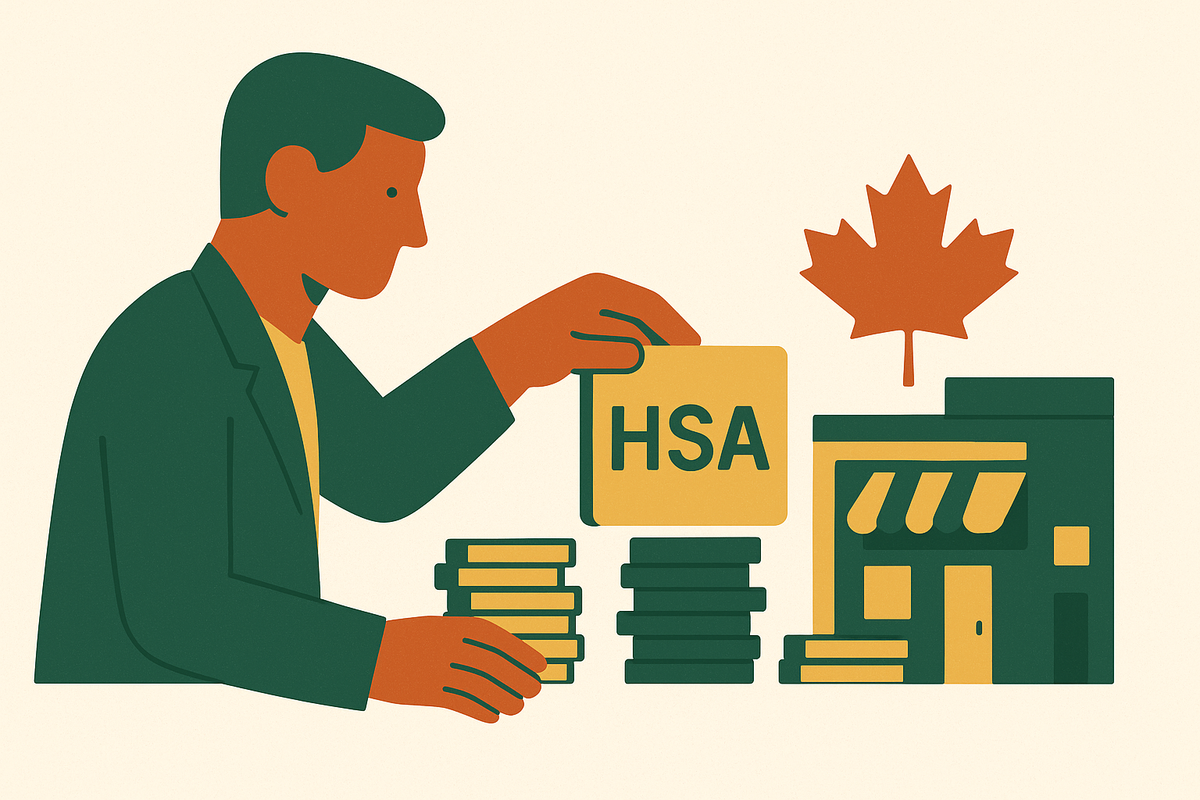
Offering Employee Benefits Choice Through an HSA Spending Account
Let employees direct benefits dollars toward their actual health priorities.

A 28-year-old with no kids, a parent covering a child's braces, and an employee managing a chronic condition don't need the same health plan. They need the same dollar amount pointed in three different directions, and that's the whole idea behind a Health Spending Account. This structure is why more small businesses are picking it over a group plan built for an average employee who doesn't actually exist.
Small businesses can offer personalized benefits on a tight budget by funding a Health Spending Account instead of a fixed group plan. The employer sets one annual dollar amount per employee, then each person directs that money toward whichever eligible expenses matter to them: dental, therapy, physio, prescriptions, vision, or any other qualifying category. Employer cost is capped at that ceiling and tied to actual approved claims, so a low-use year costs less than budgeted rather than running at full premium regardless. Research consistently shows HR leaders believe personalized benefits are necessary to attract and keep talent, and this structure delivers that flexibility without requiring a large benefits budget or multiple plan tiers.
Traditional group plans get designed once, at the employer level, then handed down to everyone regardless of what they actually spend money on. Some employees over-consume coverage they don't need, while others leave money on the table because the plan never covered what mattered to them, whether that's therapy, orthodontics, or physio. Small businesses feel this mismatch harder than big ones, since they rarely have the budget or the leverage to run multiple plan tiers. One plan has to fit everybody, and it usually doesn't: half the team feels over-insured, the other half feels ignored, just on different line items. Research consistently shows HR leaders believe employers need to offer personalized benefits just to attract and keep talent. Employees increasingly think of benefits as part of total pay they should get to direct, rather than a fixed package dropped on their desk, and that shift is the whole reason this structure is worth taking seriously, and worth getting right.
What an HSA spending account actually is and how the money moves
A Health Spending Account is a pool of money, funded by the employer, the employee, or both, that the account holder draws from to pay eligible health expenses. The feature that actually separates it from insurance is ownership: the money belongs to the employee, and it rolls forward at year's end rather than disappearing.
Here's how the mechanics work. The employer sets an annual contribution, a budget per person, and the employee submits an eligible expense and either gets reimbursed or pays straight from the account. Anything unused at year's end stays put for next year.
Eligible expenses cover a long, specific list: dental, vision, prescriptions, paramedical services, medical devices, mental health care. Exact rules shift by jurisdiction and plan design. In Canada, the account runs under federal tax guidelines that govern which expenses are eligible. That structure differs from the US triple-tax-advantaged HSA model, but the underlying logic, letting the employee choose where the money goes, is identical on both sides of the border. This is where people get tripped up: the acronym is shared, the tax mechanics are not, and conflating the Canadian and American versions is where most of the confusion starts.
No premium gets paid for coverage nobody uses. Dollars move only when a real, eligible claim gets filed. Most modern plans handle this digitally, so claims get submitted and tracked without paper forms or a broker sitting in the middle of every transaction.
The range of expenses employees can actually direct their dollars toward
The eligible-expense list is what makes the choice real instead of theoretical. Employees can put money toward dental work like cleanings, fillings, and orthodontics. Vision care covers glasses, contacts, even laser eye surgery, while mental health spending covers therapy and counselling. Paramedical services span physiotherapy, massage, chiropractic care, and naturopathic treatment. Add prescription drugs, medical devices, fertility treatment, hearing aids, and certain surgical procedures, and the range starts looking less like a benefits package and more like an actual health budget.
Nobody gets forced into a use-it-or-lose-it trap on any single category. An employee who never sees a chiropractor doesn't waste those dollars sitting idle in some unused benefit line, and someone who needs physio every week can push more of the budget there. The result is a fixed total with a flexible menu underneath, in contrast to fixed coverage carved up by category before anyone knows what they'll actually need.
Compare that to a typical small business group plan, which might cover a set percentage of dental up to some annual cap but next to nothing for massage or vision beyond a token allowance. The coverage decision in that model belongs to the employer. With an HSA, it belongs to the person spending the money, and that's the correct place for it to sit.
Why the rollover feature changes how employees think about their benefits
Flexible spending plans built on a use-it-or-lose-it model push people to spend at year's end whether they need to or not, which is a strange incentive to bake into a health benefit. HSA rollover flips it: the unused balance carries forward, so someone with a quiet health year builds a cushion for the year they need major dental work, surgery, or a prescription that actually costs something.
The behavior shift is real. Employees stop making artificial December spending decisions and start treating the account like a health budget they own over time. PSCA found average HSA balances in the US climbed to $6,489 by the end of 2024, up from $6,165 the year before. That's not a huge jump, but a steady direction, and the direction is the signal: people are letting the account build instead of draining it on schedule.
For a small business, rollover means an employee who barely touched the account this year isn't sitting on wasted budget. The employer only pays out on approved claims, so a low-use year costs less. Rollover also kills the year-end scramble HR usually deals with: no employees hunting for eligible expenses before some arbitrary deadline just to avoid losing money they already earned.
How rising health costs make employee-directed benefits more urgent, not less
Health costs aren't leveling off, and pretending otherwise is the mistake most small businesses make when they budget benefits one year at a time. KFF's 2025 Employer Health Benefits Survey put average annual premiums for employer-sponsored family coverage at $26,993 in 2025, a 6% jump over 2024, and that's a multi-year climb with no sign of flattening out.
For a small business paying fixed premiums, that math gets harder to justify every year, regardless of whether employees actually use the plan they're paying into. Employees feel the pressure directly too, not just as a line on a company balance sheet. A meaningful share of employees take on debt to cover unexpected health expenses, a cost employers rarely see, sitting quietly on someone's credit card.
When healthcare spending gets this expensive and this unpredictable, a benefit that lets employees route dollars to their single highest-priority need produces more real value per dollar than a fixed plan. An HSA with real funds sitting in it gives an employee a way to handle a surprise expense without going into debt over it, a benefit doing its actual job.
What employer participation in HSAs actually looks like in practice
Employer involvement is the norm in this market. TrueMed's data shows 61% of US HSA accounts, roughly 24 million of them, are employer-affiliated. Among employers that contribute, PSCA's 2026 survey found 61.3% set a fixed contribution tied to coverage level, a predictable number that's easy to budget around.
Contribution size spans a wide range: about 32% of contributing employers put in between $500 and $1,000 per worker a year, 29% contribute $1,350 or more, and 22% put in $500 or less per worker. There's no single "standard" to benchmark against, and that's the real finding here. The spread shows small businesses have room to enter at whatever level fits, instead of chasing some industry norm that doesn't exist.
In a Canadian Health Spending Account, the employer's job is narrow: set an annual budget per employee, sign off on the plan structure, pay only on approved claims. No actuarial guesswork, no premium negotiation with an insurer every renewal cycle. Fee models built around a flat percentage on approved claims, rather than a flat annual cost, mean total employer spend only gets known once a claim actually happens, with no setup fee, no annual fee, no premium paid on coverage nobody touched. Traditional insurance runs on a different logic: the premium is fixed and due no matter what, so a small business with a young, healthy staff can end up paying full freight while barely filing a claim all year.
The knowledge gap that keeps employees from using the benefit they've been given
Here's the uncomfortable part, and it's the real failure point in this whole system. Research has found that a large share of benefit-eligible employees cannot even identify an HSA as something their employer offered. Sit with that for a second: nearly two-thirds of people with access to this benefit don't know it exists.
Research consistently finds a large share of employees report being confused by their benefits, and many simply re-elect whatever they picked the year before without reviewing anything. Put those numbers together and what shows up is inertia driven by confusion, a different problem and a fixable one. The rollover feature is widely cited as the one most likely to change how someone thinks about the benefit, and also the one fewest people understand.
None of this works as a choice mechanism if employees don't know what they can spend the money on, how to file a claim, or that unused funds are theirs to keep. Small businesses actually hold an advantage here: a 12-person team is far easier to walk through this than a large enterprise. A 15-minute onboarding conversation, a clear list of eligible expenses, and a simple digital claim tool close most of the gap. The job is clearing the confusion sitting between employees and money they already have.
How to set up an HSA structure that gives employees real flexibility without unpredictable cost for the business
Step one is setting the annual budget per employee. That number is the employer's only fixed commitment, and everything downstream depends on actual claim activity, not projections: the business is capping a ceiling, not guessing at a premium.
Small businesses typically pick from a few budget structures. Some go flat, the same amount per employee regardless of role. Others tier by employment status, full-time versus part-time, or by family size, and some scale the amount by seniority or years of service. Whatever the structure, the budget is a ceiling, not a guarantee of spend: if an employee claims $400 out of a $1,500 allotment, the employer pays administration fees on $400, not the full $1,500.
CRA rules govern the eligible-expense list in Canada, so the employer never has to personally judge whether a claim qualifies; the plan administrator handles that. Digital administration removes the main objection small business owners raise, since there's no paper trail to manage, no dedicated benefits coordinator needed, no insurer to renegotiate with every year. Most plans also extend to spouses and dependent children, which expands the value for employees with families without forcing the employer to build a separate family tier. Claim records and reimbursements leave a clean trail for payroll too, without manual reconciliation at year's end.
One caveat worth stating plainly: an HSA doesn't replace catastrophic coverage. Employees facing high-cost emergency or hospital care still need separate insurance for that, since an HSA is built for predictable and semi-predictable spending, the orthodontics, the physio, the therapy, a narrower job than serving as the whole safety net.
Why can small businesses attract and retain employees with personalized benefits on a tight budget?
Traditional group insurance can be difficult for the smallest firms to access at competitive rates, and qualifying for coverage at all is not guaranteed.
Even when a small business does qualify, fixed premiums on a small headcount mean the employer carries the full actuarial risk, and one bad health year for a single employee can shift the whole group's renewal rate the following year. Incorporated professionals, dentists, engineers, consultants, physicians running professional corporations, face a specific wrinkle too: a Health Spending Account may offer tax advantages for the corporation, depending on how the plan gets structured and the specifics of the employment relationship. Tax treatment varies by circumstance, so it's worth getting a professional opinion rather than assuming.
The pay-as-you-go model lines cost up with actual use. A business that sees lower-than-budgeted claims pays only on actual claims, and that gap is money that simply didn't need spending this year. Administration costs are tied to actual claim activity rather than a fixed premium, which removes the renewal negotiation cycle from the equation.
That's the real case here, once the incentives on both sides get worked through. Small businesses choosing an HSA over a traditional group plan are funding something only when employees actually use it, which is more honest and more efficient for everyone involved. The employees who gain the most are the ones with specific, recurring needs, orthodontics, therapy, ongoing physio, who've historically found group plans too narrow to bother with. An HSA meets them exactly where their spending already sits, a better trade than a fixed plan built for an employee who doesn't exist.