HSA Taxation Rules for Incorporated Professionals in Canada
HSA plans can cut incorporated professionals' healthcare costs by 25% to 40%.

An HSA (Health Spending Account) lets a Canadian corporation pay an employee's medical bills, deduct the whole amount, and hand the money over completely tax-free on the other end. Two things happen in the same transaction. The corporation reimburses a dental bill or a physio session, and that reimbursement, plus whatever fee the plan administrator charges, comes off taxable corporate income dollar for dollar. No phase-out, no partial credit tied to income level.
The employee sees none of it on a T4. It never touches personal taxable income at all.
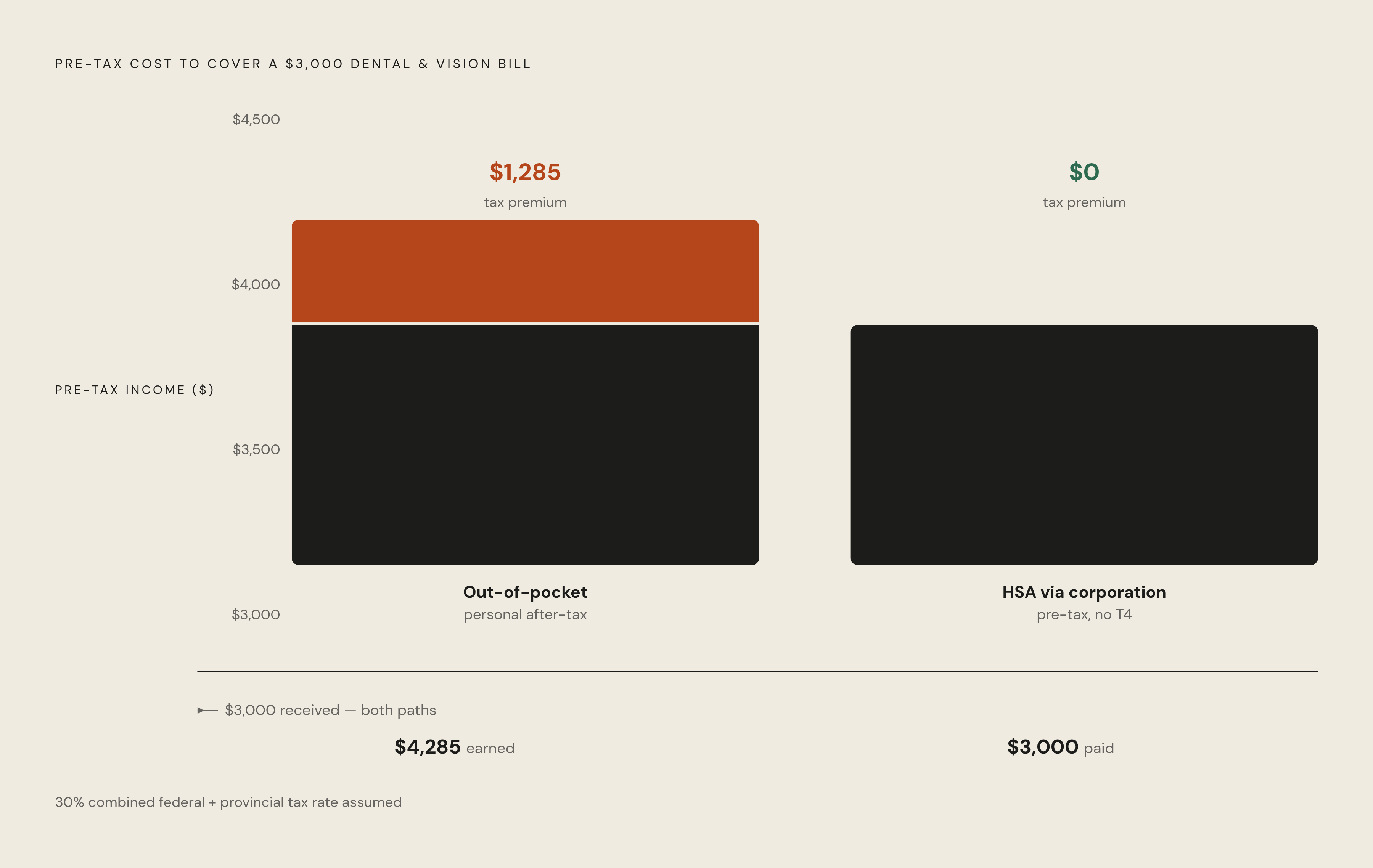
Run the math against paying out of pocket, and the gap is hard to argue with. A professional who owes $3,000 for dental and vision work needs to earn roughly $4,285 in pre-tax income at a 30% tax rate just to clear $3,000 after tax. Push that same $3,000 through an HSA instead, and the corporation pays $3,000 pre-tax, the professional receives $3,000, full stop. That's a gap of about $1,285 on one claim, and depending on the corporation's tax bracket, savings generally land somewhere between 25% and 40%.
Admin fees ride along in the deduction too. Most HSA providers charge around 8% to 10% of claims processed, and that fee is deductible right alongside everything else. The whole invoice comes off corporate income, not just the portion that covered the dental work.
Quebec breaks this differently. Amounts reimbursed through an HSA still dodge federal tax there, but Revenu Québec taxes them provincially and requires them to be reported. Anyone incorporated in Quebec needs to build that into the math before assuming the savings match what's described above.
Compare all this to the Medical Expense Tax Credit, the tool most people reach for when there's no corporation in the picture. METC gives a 15% non-refundable credit on eligible expenses above 3% of net income. A 25% to 40% corporate deduction is not in the same category, and treating the two as roughly equivalent is a mistake. If a choice exists between them, the HSA wins for anyone already incorporated. There's no real argument the other way.
Why incorporation is the structural prerequisite, and what the employee relationship requires
Any incorporated business qualifies: professional corporations, consulting firms, contracting corporations, one-person operations. There's no headcount minimum. A single-owner corporation can build a plan covering just the owner and their dependants, and that's the most common setup by a wide margin.
CRA attaches three conditions to the owner-shareholder specifically, spelled out in Technical Interpretation 2003-0050541E5. The owner has to be actively working in the business, not just holding shares and cashing dividends. The benefits given have to resemble what an arm's-length employee doing similar work would reasonably get. And the owner needs an actual employment relationship with the corporation: something in writing, something that makes them an employee rather than a shareholder collecting perks.
Doctors, dentists, and lawyers running incorporated practices are the obvious fit, since their out-of-pocket medical costs already run high. Consultants and freelancers working through a one-person corporation get something different out of it: a way to cover their own healthcare without the cost and paperwork of group insurance, while keeping the tax treatment on their side.
Sole proprietors are stuck with a much narrower version of all this. Without incorporation, a PHSP only becomes available if there's at least one arm's-length employee, someone who isn't a spouse or family member unless that person genuinely operates at arm's length. Even then, the personal benefit is capped at $1,500 per adult and $750 per child annually, under IT-339R2. Incorporating removes that statutory ceiling. Limits still have to be reasonable, but reasonableness turns into a judgment call instead of a number fixed in legislation, and that shift is the real value incorporation buys here.
The shareholder-versus-employee distinction: the compliance risk most incorporated owners underestimate
CRA's default assumption cuts against the owner. If a shareholder has real influence over how the business runs, CRA presumes any benefit they receive flows from owning the company, not from being employed by it. That single assumption decides whether the whole structure holds up or collapses.
Section 15(1) of the Income Tax Act does the enforcing. If a corporation confers a benefit on a shareholder, that amount gets added to the shareholder's personal income, and the corporation loses its deduction on the same amount. Taxed to the individual, not deductible to the company: a double hit, not a wash. CRA's guidance addresses this exact scenario directly. A benefit received as a shareholder, rather than as an employee, doesn't get tax-free treatment. Period.
This is where a lot of incorporated owners trip themselves up, and it's an easy mistake to make without noticing. Plenty pay themselves entirely in dividends, since that skips CPP contributions and can work out better depending on the bracket. But dividends flow to shareholders, not employees, and no T4 income means no employment relationship on paper. If CRA ever pulls the file and finds PHSP reimbursements claimed by someone with zero salary income, the whole benefit gets reclassified as a shareholder benefit under s.15(1), and both the deduction and the tax-free receipt vanish together.
The fix isn't complicated, even if it's a little annoying to administer: keep a payroll account open, and issue a T4 every year, even a modest one. What salary actually makes sense is a separate conversation with a tax advisor, since it depends on the corporation's income and the rest of the owner's compensation mix. But skipping payroll to dodge CPP, then trying to run an HSA on top of pure dividend income, is precisely the setup CRA is positioned to unwind. Don't build it that way.
There's a door left open, though. When every employee at the corporation happens to be a shareholder, and the benefits given are consistent across the group, CRA's guidance says the benefit is "normally considered to be an employment benefit rather than a shareholder benefit." An all-shareholder company isn't disqualified on its face. It only holds up when the plan is built with real employment terms behind it, not assumed into existence because the owner also happens to be on payroll somewhere.
Structuring the plan so it survives CRA scrutiny
A PHSP has to exist on paper before a single dollar moves. Informal reimbursements paid straight from an owner's account, with no plan document behind them, don't qualify, no matter how legitimate the medical expense was.
Spending limits need to lock in before the benefit year starts, not after. A plan that lets the owner raise the ceiling mid-year, right after a big dental bill shows up, stops looking like an HSA and starts looking like discretionary cash. That's exactly the pattern CRA watches for.
Limits also need to track across similar roles. An owner with a $10,000 allowance next to a staff member doing comparable work at $500 isn't a footnote, it's a flag, and it's the kind of gap that draws a review.
Money needs to move through the corporation, never straight from a personal account to a clinic or pharmacy. Most incorporated owners bring in a third-party administrator for this: the administrator checks each claim against CRA's eligibility rules, processes the reimbursement, then bills the corporation for the claim plus its own fee, typically 8% to 10% of the total. That full invoice is what gets deducted.
One-person corporations face a specific trap, and it deserves to be named directly rather than softened. CRA has said a cost-plus arrangement where an administrator simply reimburses a sole employee-shareholder and their family for whatever they spent, with nothing else built into the plan, may not contain the elements of insurance a PHSP requires, and can fail to qualify at all. That's a structural risk, not a technicality, and it's exactly why plan documentation matters more for single-owner corporations than for anyone with a larger team.
No dollar cap exists in the legislation for what counts as reasonable, but providers commonly suggest keeping contributions under 25% of an employee's gross salary as a rule of thumb. Most owner-run plans land somewhere between $1,500 and $5,000 per family member per year. Go well past that without justification, and CRA may treat the excess as disguised compensation instead of a medical benefit. And if the corporation has fewer than two arm's-length employees, the sole-proprietor caps snap back into place: $1,500 per adult, $750 per child.
What the HSA actually covers, and what gets missed
CRA defines the eligible expense list, the same list used for the Medical Expense Tax Credit under section 118.2(2) of the Income Tax Act. The HSA doesn't expand what counts as medical. It changes who pays and how the tax works on it.
The core categories run through prescription drugs, dental work of nearly every kind (cleanings, fillings, crowns, orthodontics, wisdom teeth), vision care (exams, glasses, contacts, laser surgery), and paramedical services like physiotherapy, chiropractic care, and massage therapy, though massage generally needs a prescription behind it to qualify. Mental health counts too: sessions with a licensed psychologist or a psychiatrist are explicitly recognized. Medical devices, orthotics, hearing aids, and braces round out the list.
What actually surprises people is how much falls outside the obvious buckets and still qualifies. Laser eye surgery is fully reimbursable. So are fertility treatments, IVF and IUI included, along with the prescriptions tied to them. Private hospital rooms count too, as long as medical documentation shows they're required, not just preferred. Medical travel, mileage, meals, accommodation, becomes eligible once the distance passes 40 km. Medical cannabis qualifies with a prescription from a licensed producer. Even gluten-free products can count, partially, when a doctor has prescribed them for celiac disease and the receipts are itemized properly.
Not everything clears the bar. Cosmetic procedures like teeth whitening or elective cosmetic surgery are excluded outright unless a doctor deems them medically necessary. Over-the-counter products without a prescription don't qualify, and neither do general personal care items. CRA's publication RC4065 is worth checking when something's unclear, though it's guidance, not law, and it doesn't override the Act.
For a family already spending several thousand dollars a year on dental, vision, and paramedical care, none of this asks for new spending. It reroutes existing spending onto a plan that turns it into pre-tax corporate dollars instead of after-tax personal ones.
How an HSA stacks up against the alternatives
Most professionals are still paying for healthcare the plain way: personal after-tax income, no structure behind it. That's the real baseline, and it's the one worth measuring everything else against, not some idealized comparison between two equally good options.
The Medical Expense Tax Credit sits below both the plain approach and the HSA. Anyone can claim it, incorporated or not, but it only returns 15% on eligible expenses beyond a threshold tied to net income, a non-refundable credit with a payoff nowhere near a corporate deduction. And the two can't stack: whatever gets reimbursed through the HSA can't also get claimed under METC.
Group insurance is the other comparison people bring up, and it solves a different problem than an HSA solves. Fixed monthly premiums come due whether or not anyone files a claim that month, which is the exact inefficiency an HSA is built to avoid for a small team. Coverage tiers are fixed too, with little room to tailor benefits to one owner's spending pattern versus another's, and underwriting adds administrative weight on top of that. Group insurance still earns its place when a business needs pooled risk, disability coverage or catastrophic drug costs spread across a bigger group. But for a one- or two-person corporation paying routine dental and vision bills, it's the wrong tool, and reaching for it out of habit wastes money every month nobody files a claim.
An HSA through a third-party administrator works differently: the corporation pays only for claims that actually happen, plus the admin fee, with no premium sitting there for coverage nobody used. That pay-as-you-go shape fits how most small incorporated businesses actually run. Some split the difference, a basic group plan for catastrophic risk, an HSA for everyday costs. It doesn't have to be one or the other.
Adoption keeps climbing among Canadian employers, though most incorporated professionals still haven't set one up. The gap between knowing this exists and actually building it stays wide open, mostly because the compliance details above scare people off before they reach the payoff.
What to do, and check with an advisor, before the benefit year starts
Confirm the corporation is a genuine CCPC, and confirm the owner's role clears CRA's employee test: active in the business, paid a reasonable T4 salary, working under a real employment arrangement rather than just holding shares and collecting dividends. Nail this down first. Nothing else on this list matters if this piece isn't solid.
Get the plan documented in writing before a single claim runs through it. Set the annual spending limits now, for the year ahead, not retroactively once a big bill shows up. Check that limits stay consistent across anyone else on payroll doing comparable work, and route every reimbursement through the corporation and a plan administrator, never straight from a personal account.
Sole owners need to take the cost-plus risk seriously. A bare-bones arrangement reimbursing one shareholder-employee's bills, with no other structure behind it, is exactly the setup CRA has flagged as potentially falling short of a real PHSP. Build the plan properly instead of betting that a stripped-down version holds up under review.
Run the actual numbers with a tax advisor before assuming any of these savings apply automatically. Salary level, current dividend mix, provincial residency (Quebec's carve-out matters here), and the size and shape of expected medical expenses all change what the structure is worth in a given year. CRA has recognized the tax treatment itself for decades, so that part isn't in question. Whether it fits a specific corporation, and how it should get built, takes an advisor and an actual look at the numbers, not a general article.
Sources
- Health Spending Account for Incorporated Businesses in Canada | Wealthsimple
- Health Spending Account Canada: Setup, CRA Rules & FAQs - PurposeCPA
- Health Spending Account Benefits in Canada: Tax-Free & Flexible
- TaxTips.ca - Small Business - Private Health Services Plans (PHSPs)
- thinkaccounting.ca
- conductlaw.com