Ontario HSA Retail Sales Tax and Insurance Premium Tax Explained
Employees get tax-free reimbursements while employers pay provincial taxes on the benefit itself.
If you use a Health Spending Account in Ontario, you regularly find provincial tax charges on your invoices, even though your employees' reimbursements arrive completely tax-free. The surprise hits hardest for employers who switched from a provider that never charged these taxes before. That silence on past invoices did not mean the tax never applied. It meant the tax went uncollected or undisclosed. The confusion traces back to one habit of thought: treating the tax status of the benefit and the tax status of the transaction delivering it as the same question, when they are legally separate matters. Untangling that distinction is what the rest of this piece sets out to do.
Why a Benefit Can Be Tax-Free While the Transaction Delivering It Is Taxed
Federal tax law and Ontario provincial tax law are answering two different questions, and both answers can be true at once. Under CRA rules, a Private Health Services Plan gives employees tax-free reimbursements and gives employers a full business deduction, but those federal advantages govern the benefit itself, not the provincial treatment of the insurance or administrative mechanism that delivers it. Ontario tax law looks at the same arrangement from a different angle. It treats HSAs as benefit arrangements or insurance-like transactions at the plan level, and that provincial characterization is what triggers Retail Sales Tax and Insurance Premium Tax.
These two layers run independently of each other. The federal layer, governed by the CRA and the Income Tax Act, decides whether the benefit counts as taxable income to the employee and whether it's deductible for the employer. The deduction is yes, and the employee income is no, and the provincial layer, governed by the Ontario Ministry of Finance, decides whether the transaction itself, the insurance or benefit arrangement, is subject to provincial levies. The answer there is yes, applied at the plan level. Because these two layers don't talk to each other, the result looks contradictory on paper: the employee's reimbursement carries no tax at all, while the employer's invoice shows two separate provincial charges. Nothing about that is a mistake or a pricing error. It's simply two different legal systems looking at the same dollar and asking different questions.
Why RST Survived Ontario's Move to HST
Retail Sales Tax on benefit arrangements is not a leftover oversight from before Ontario modernized its sales tax system. It was kept on purpose. When Ontario joined the HST system on July 1, 2010, it eliminated most of its provincial sales tax on goods and services, but it deliberately held onto an 8% provincial levy on insurance premiums and benefit arrangements. That retained levy is Retail Sales Tax, and it operates on its own track: the Ontario Ministry of Finance administers it, it sits outside HST entirely, and unlike HST, a business can't recover it through an input tax credit. Because RST lives outside the HST framework, the fact that insurance is exempt from GST/HST does nothing to shield benefit arrangements from RST. The two systems were built to run in parallel, not to overlap. Ontario Ministry of Finance guidance confirms the scope directly: RST applies to insured group health and dental plans, to Health Spending Accounts structured as PHSPs, and to administrative services tied to insurance-type benefit arrangements.
The Three Taxes on an Ontario HSA Invoice
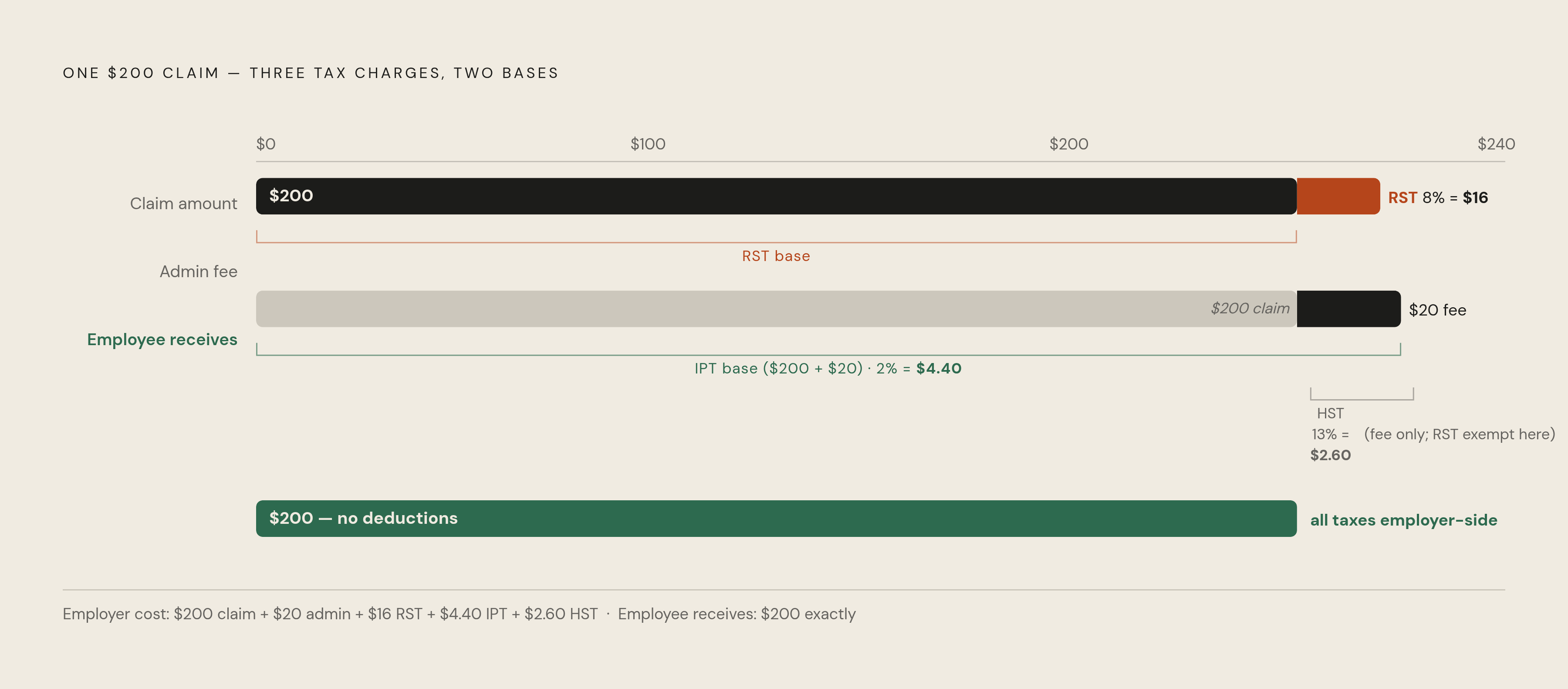
An Ontario HSA invoice can carry up to three separate charges, and each one has its own base and its own legal origin. Once you know which dollar amount each tax is calculated against, the numbers on the invoice stop looking arbitrary.
Retail Sales Tax runs at 8% and applies to the claim amount, which is the actual medical expense the employee submitted. The employer pays it, it can't be recovered as an input tax credit, and it never touches the employee's reimbursement or the employee's own tax situation.
Insurance Premium Tax runs at 2% and applies more broadly: both to the claim amount and to the administration fee charged for processing it. IPT is a distinct obligation from RST. Collecting and remitting one does not mean the other has been handled, a gap that has drawn active enforcement attention and is covered in more detail further on.
HST runs at 13% and applies to the administration fee for processing claims. HST isn't an Ontario-specific charge; it applies in every province. Where part of the administration fee is already subject to HST, that same portion is exempt from RST, so the two taxes never stack on the same dollar.
Ontario is not unique in layering provincial tax onto benefit arrangements, but it belongs to a small group of provinces that do this. RST on the claim amount applies in Ontario, Quebec, and Manitoba, while most other provinces charge only GST or HST on the administration fee and leave the claim amount untouched.
| Province | RST on claim amount | Tax on admin fee | |---|---|---| | Ontario | Yes (8%) | HST (13%) + IPT (2%) | | Quebec | Yes | GST/HST applies | | Manitoba | Yes | GST/HST applies | | Most other provinces | No | GST/HST only |
What an Ontario HSA claim costs an employer, worked through a concrete example
Take an example drawn from Hiveworks' Ontario HSA page: an employee submits a $200 dental receipt. The employee is reimbursed the full $200, tax-free, with no deduction for any of the provincial charges sitting elsewhere on the invoice. RST at 8% and IPT at 2% both apply to that $200 claim amount, adding their respective charges on top of what the employer pays, not on top of what the employee receives. The employer deducts the full invoiced amount, taxes included, as a business expense, and the employee still walks away with the full $200, untouched by any of it.
Scaling the same claim up to a larger dollar amount changes nothing about the structure. RST and IPT each add their percentage on top of the claim, so the employer pays the grossed-up total, but the employee still receives the full claim amount regardless of size. The administration fee carries its own charges, HST and IPT, calculated separately from the claim amount, so the full invoice combines both sets of charges.
RST and IPT together add a predictable percentage uplift to every approved claim, so once an employer knows that uplift, forecasting the provincial tax load on a year's worth of claims becomes a straightforward multiplication exercise.
The Employer's Legal Obligation for These Taxes
The obligation to remit RST and IPT belongs to the Ontario employer by law, not to the HSA administrator managing the plan, and many employers only learn this after switching providers and seeing the charges appear for the first time. The Ontario Ministry of Revenue's position, as EasyHSA's Ontario HSA guide states directly, is unambiguous: if an HSA administrator isn't collecting RST and PPT, the responsibility falls on the employer to register for RST and PPT accounts and remit on a regular schedule, or face penalties.
Where the employer is located determines the obligation, not where the HSA provider happens to be based. An out-of-province provider carries no exemption that protects an Ontario-based employer from Ontario's rules. HSA providers themselves face no penalty for failing to collect or remit RST and IPT, and they carry no legal requirement to tell employers these taxes even apply, a gap that creates a structural incentive for providers to stay quiet about it.
Where a provider doesn't collect the tax, the employer has to self-assess and remit directly to the Ontario Ministry of Finance within the prescribed period following the month the premium or claim was paid. A plan counts as funded when contributions exceed what the plan needs to cover benefits that are foreseeable and payable within 30 days. The risk compounds over time rather than resetting with each new provider: an employer who went uncharged in the past wasn't exempt from the obligation during that time. The tax was still owed, and the liability kept accumulating in the background. A compliant arrangement is one where the employer knows, independent of what any invoice shows, whether RST and IPT registration and remittance are happening, either through the provider or through the employer's own filing.
RST compliance and IPT compliance are separate obligations that are easy to conflate
Remitting RST and remitting IPT fall under different Ontario statutes, and satisfying one does nothing to satisfy the other, a distinction that matters most for employers running funded benefit structures and less for a typical small business running a straightforward HSA.
IPT isn't limited to premiums paid to an insurance carrier. It can also apply to contributions made into funded benefit arrangements, including employee life and health trusts, whenever those contributions exceed what the fund needs to cover foreseeable benefits within 30 days, a rule Ontario put in place back in 1996. So if you run multi-employer plans or other funded benefit arrangements, RST compliance alone, even done correctly, leaves a separate IPT question still open. If you run the more common single-employer HSA arrangement, this layer is less likely to come into play, but it's part of why funded plans have drawn fresh regulatory attention, which the next section covers directly.
Ontario's Proposed 2026 IPT Simplification for Funded Benefit Plans
Enforcement activity in 2025 around these obligations led directly to a legislative response. As part of Budget 2026, the Ontario Ministry of Finance announced a proposal to simplify the IPT regime for employee life and health trusts, as KM Law's Ontario IPT update reports. The proposal would let all funded benefit plans, ELHTs included, elect to be treated as unfunded benefit plans, effective April 1, 2026.
For ELHTs currently classified as funded plans, making that election would shift when IPT becomes payable: instead of being charged on contributions going into the fund, it would be charged on benefits at the time they're actually paid out. In practice, that timing shift often lowers the overall IPT burden carried by the plan sponsor. You can expect formal guidance from the Ontario Ministry of Finance, along with a revised IPT tax return for reporting remittances, in fall 2026. Employers running funded benefit structures in Ontario have reason to watch for that guidance closely, since it will determine how the election works and what filing changes come with it.
Sources
- Understanding Taxes on HSA and WSA Claims in Ontario | myHSA Help Centre
- Corporations Tax: Insurance Premium Tax
- Insurance and Benefits Plans | Retail Sales Tax
- Ontario HSAs: Why RST and Insurance Premium Tax Apply | Hiveworks
- Ontario HSA Tax Explained: Why Health Spending Accounts Still Have RST
- Ontario Health Spending Account (HSA) Tax Rules - EasyHSA
- Health Spending Account Ontario: Set up a Corporate HSA
- Taxes on Health Spending Accounts - Lifeaccount