Coordinating an HSA With a Spouse's Group Benefits Plan
Canadian employers must submit group plan claims first, with HSAs covering deductibles and gaps.
When one spouse has a group benefits plan through work and the other holds an HSA, a specific sequence decides which plan pays first, what flows to the HSA, and how much of the household's eligible spending actually gets reimbursed. Get that sequence right, and two separate plans start acting like one coordinated system. In the US system, by contrast, HSA eligibility is judged on an individual basis: each person must independently meet IRS tests, including HDHP enrollment, no disqualifying other coverage, no Medicare enrollment, and not being claimable as a dependent on someone else's return.
Two plans in one household not automatically working together
Picture the standard dual-income household: one spouse carries group benefits through an employer, the other manages health spending through an HSA. The assumption most people make is that two plans means double the coverage, stacked on top of each other like two blankets on a cold night. That's not how it works. Without a clear grasp of the coordination sequence, households end up leaving eligible expenses unclaimed, or worse, submitting them to the wrong plan first.
None of this is theoretical. Get the order wrong and claims get denied, reimbursements go missing, and in the HSA context, mistakes can trigger contribution penalties. Canadian HSAs run under CRA rules governing Health Spending Accounts, a different framework from the US IRS system. Confuse the two, and every downstream decision gets shakier. This article resolves which plan pays first, what the HSA can cover after the group plan has acted, and how to set up the household's claims process so nothing eligible is missed.
How coordination of benefits works in Canadian group plans
Canadian group insurers rely on a standard process called Coordination of Benefits, or COB, whenever someone has more than one source of coverage. COB applies whenever access to two or more group plans exists at once, whether that's an employee's own plan plus a spouse's, two simultaneous jobs, a student plan alongside parent coverage, or a retiree plan alongside new employment benefits. The core rule: the plan under which the person is the direct member, not a dependant, pays first. That's the primary plan.
Dependants get a slightly different rule. When a child is covered under both parents' group plans, the plan belonging to whichever parent's birthday falls earlier in the calendar year is typically treated as primary. That's a common industry convention, not a law, so the actual plan documents always have the final word.
Once the primary plan pays its share, the secondary plan steps in to cover some or all of what's left, up to 100% of the actual expense. Nobody profits from having two plans; the system is built to top up, not double-pay. The place to confirm all of this for a specific plan is the benefits booklet or certificate of insurance, which spells out that plan's own COB rules. Read it before submitting anything.
One distinction trips people up constantly: COB does not create coverage where none exists. If a group plan categorically excludes something, or an amount sits above its reasonable-and-customary limit, that amount stands as ineligible, with no secondary plan obligated to mop it up. It's just ineligible, full stop, under that plan's terms.
Where the HSA enters the sequence
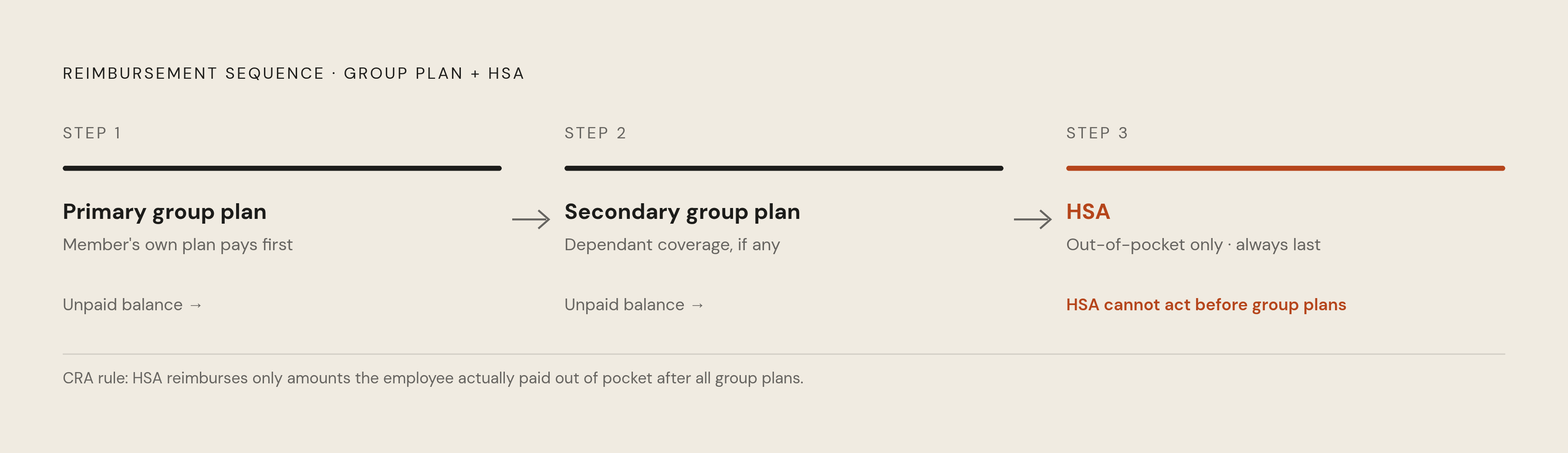
A CRA-governed HSA is a defined-contribution arrangement, not an insurer, and it does not "coordinate" with other plans the way two group insurers do, though it reimburses CRA-eligible medical expenses. That distinction matters because it changes the order of operations for a household holding both.
The sequence for a household with one group plan and one HSA runs as follows. First, the claim goes to the group benefits plan, since that's the primary payer. Second, if the patient also happens to be a dependant under a second group plan, whatever balance remains goes there next. Third, and only then, whatever is still unpaid gets submitted to the HSA.
The HSA goes last for a specific reason: it can only reimburse money the employee actually paid out of pocket. Submit an expense the group plan already covered, and that's double-dipping, something CRA does not permit. So the HSA's real value in a two-plan household lies elsewhere, as a payer of last resort rather than a primary one. It's the tool that mops up the residual, the deductibles, the co-pays, the co-insurance gaps, and whatever the group plan simply doesn't touch. It supplements after the group plan has acted; it never reduces what the group plan owes.
HSA reimbursement after the group plan has paid
Once the group plan has done its work, several categories of residual cost typically remain, and these are what the HSA is built to absorb. Deductibles the group plan requires the member to cover before benefits kick in are one. A plan that reimburses 80% of an approved claim leaves the remaining 20% as a patient balance, another example of a co-insurance gap PeopleKeep How HSA contribution limits work for spouses.
Amounts above a plan's reasonable-and-customary ceiling for a given service fall into the same bucket, as do benefit maximums. Once a group plan's annual cap for a category like paramedical services or prescription drugs runs out, whatever eligible spending remains for the rest of that benefit year flows to the HSA instead.
Then there's the category of things the group plan never covered at all. Certain dental and vision expenses, depending on how the group plan is structured, plus specific medical equipment and devices, and eligible costs for a spouse or dependant who isn't on the group plan's coverage in the first place. All of it still has to clear CRA's own eligibility list, which functions as the outer boundary no matter what the group plan does or doesn't cover.
None of this works without paperwork discipline. The HSA submission has to reflect what the household genuinely paid, and the Explanation of Benefits from the group insurer is the proof of what got covered and what's left. Keep it for every single claim.
The spouse's group plan and HSA contribution eligibility: the Canadian distinction
This is where the US and Canadian systems diverge sharply, and it's worth being precise about it. CRA-governed Health Spending Accounts are employer-funded arrangements, not employee-contribution accounts, so contribution eligibility works differently than under US HSA rules. In Canada, the employer sets the HSA spending limit, essentially an annual health budget, and the employee never contributes personal funds into it. That means there's no "contribution eligibility" question tied to whatever coverage a spouse happens to carry.
A spouse's group plan doesn't disqualify the HSA, and it doesn't shrink the employer-set spending limit either. The spouse's group plan does not disqualify the HSA or reduce the employer-set spending limit (these are independent arrangements). What the spouse's plan does influence is how much survives to the HSA reimbursement stage: a stronger group plan means a smaller residual, but the HSA stays available for whatever's left over regardless.
US HSA rules require enrollment in a High-Deductible Health Plan and impose annual contribution limits of $4,400 for self-only coverage and $8,750 for family coverage in 2026, and a spouse's FSA or HRA can disqualify US HSA contributions entirely Fidelity HSA contribution limits and eligibility rules for 2026 and 2027. None of that applies north of the border under CRA. Anyone managing a US-based HSA, cross-border employees especially, should work from the US framework separately, since this discussion is built around the Canadian model.
Handling claims for a spouse or dependants covered under both plans
Take a concrete case: a couple's child needs dental work, both parents carry group plans, and the household also has an HSA. The claim goes first to whichever parent's plan is primary, determined by the birthday rule or by whatever the plan documents actually say. Whatever balance remains after that goes to the secondary parent's plan next. Only after both group plans have paid does anything left over move to the HSA, assuming the expense is CRA-eligible and the employee whose HSA it is submits the claim on behalf of a covered dependant.
A second scenario looks different. Say the spouse has a medical expense, and that spouse isn't covered under the employee's group plan at all, only under their own. Here the spouse's own group plan pays first, since it's the only group plan in the picture. Whatever remains out of pocket can then go to the employee's HSA, since CRA permits HSA reimbursement for a legal spouse's eligible expenses. Under US rules, HSA funds can likewise pay for a legally married spouse's qualified medical expenses even if that spouse isn't covered under the account holder's own HDHP, and the same flexibility extends to any tax dependent, including adult children under 26 still on the plan.
In both cases, the documentation rule doesn't change: every HSA claim involving a spouse or dependant needs the EOB attached, showing what the group plan paid. That EOB is the evidence the HSA is reimbursing the true out-of-pocket portion and nothing more. Submitting an expense that's already been covered isn't a clerical slip. It's a CRA compliance issue, because the same dollar can't be reimbursed twice.
Setting up a claims process that works year-round
Building a process here beats reacting claim by claim. Start each benefit year by mapping the household's full coverage picture, covering every plan's deductible, its co-insurance rates, the annual maximums per category, and what each plan flatly excludes.
From there, assign a submission order before any expenses come up, deciding in advance which plan is primary for the employee, for the spouse, and for each dependant. After every group plan claim, request the EOB, since most Canadian group insurers issue these digitally now, and hold off on the HSA submission until that EOB is actually in hand. Submit the HSA claim with the EOB attached; most HSA administrators worth using accept digital uploads, and the EOB plus the original receipt makes up the complete claim package.
Keep an eye on annual maximums, too. When a category like physiotherapy or massage therapy is approaching its cap on the group plan, flag the upcoming expenses so the overflow can be timed and directed to the HSA instead of getting stranded. And at year-end, check whether unused HSA funds roll over or expire under the specific plan design; if they expire, it makes sense to accelerate eligible expenses before the period closes.
For small business owners and incorporated professionals running a pay-as-you-go HSA, the administration fee only applies to approved claims. That means there's no cost to keeping the HSA available as a backstop, even in years when the group plan absorbs most of the spending. It only costs anything the moment it actually pays out.
The most common coordination mistakes
Submitting to the HSA first tops the list. Reimburse an expense through the HSA before giving the group plan a chance to pay, and the group plan may well have covered part of it, so the HSA ends up reimbursing more than the true out-of-pocket amount.
Skipping the secondary group plan is a close second. When a spouse also carries a group plan that could cover a dependant's remaining balance, failing to submit there before going to the HSA leaves that benefit sitting unused on the table. Related to it: submitting group-plan-covered amounts to the HSA anyway, reimbursing the full expense through the HSA when the group plan already paid a portion of it. That's double recovery, plain and simple, under CRA rules.
Claiming ineligible expenses is its own trap. A group plan declining to cover something does not make that expense CRA-eligible; the HSA only reimburses what's actually on CRA's list, regardless of what any insurer decided. Letting annual group plan maximums expire unused matters just as much: not tracking benefit-year caps means missing the window to time expenses so the overflow above the cap can still flow to the HSA within the same period.
Last, and maybe most avoidable of all: not keeping EOBs. Without the group plan's EOB, there's no audit trail proving the HSA reimbursed only the genuine out-of-pocket balance. The safeguard against nearly every mistake on this list is the same one: treat the EOB as the trigger for any HSA submission. No EOB, no HSA claim.
Sources
- How HSA contribution limits work for spouses
- HSA contribution limits and eligibility rules for 2026 and 2027
- Publication 969 (2025), Health Savings Accounts and Other Tax-Favored Health Plans | Internal Revenue Service
- Guidelines for coordinating benefits with an HCSA | Benefits Canada.com
- Coordination of Group Benefits in Canada | PolicyAdvisor